
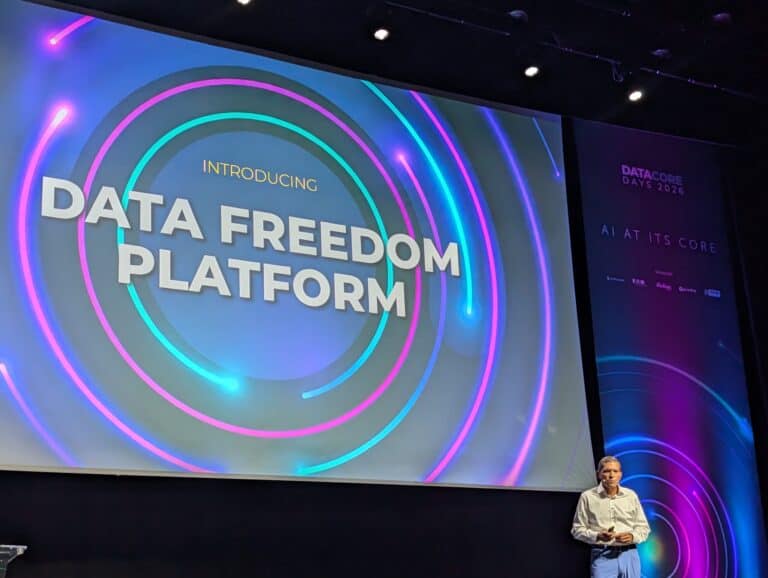
DataCore has grown significantly in recent years, offering various storage solutions for block, object, file, and container storage. This growth has often been driven by acquisitions, through which the company acquired high-quality, specialized tools. However, this also led to a siloed approach within the Software-Defined Storage (SDS) landscape. With the new unified control plane, also known as the Data Freedom Platform, everything is set to align better. We discussed this with VP of Products Said Boukhizou during the recent DataCore Days.
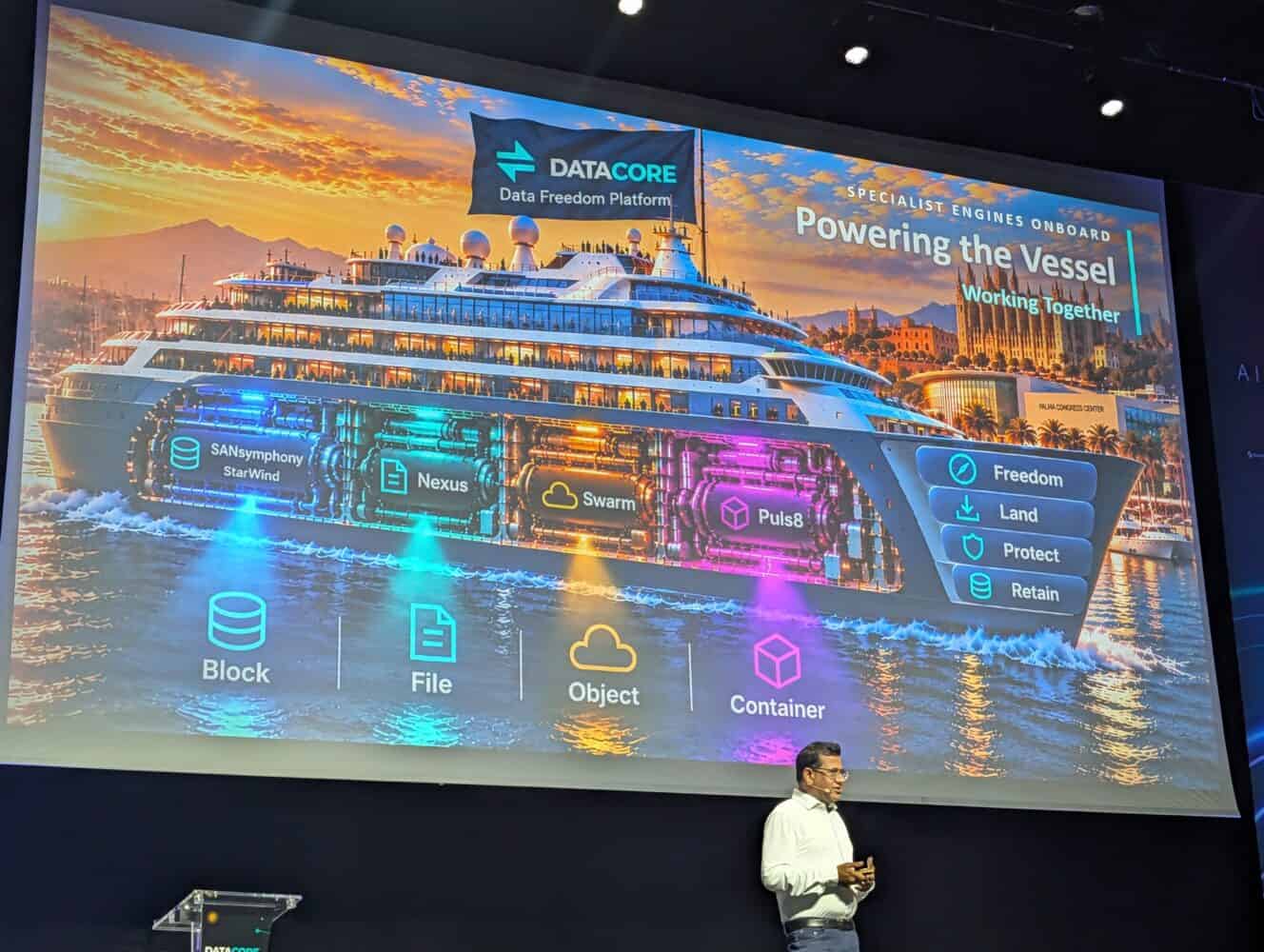
If you take a closer look at DataCore’s current portfolio, there are roughly five key point solutions. These include the company’s classic SANsymphony offering for block storage in large-scale enterprise environments, which was later supplemented by StarWind for compact locations such as the edge and SMBs. This portfolio is complemented by Swarm for large-scale, on-premises S3-compatible object storage; Nexus file storage for HPC and AI workloads; and Puls8 container storage for stateful applications within Kubernetes.
These products work well on their own but largely operate independently of one another. Because of these silos, users had to manage separate consoles. If DataCore users have a single solution, this isn’t a problem. But as the product portfolio expands, it’s becoming increasingly common for users to employ more than one point solution. In those cases, a siloed architecture can become an obstacle. Users would then build their own control planes using APIs and scripts. DataCore is now taking over that work. The open APIs will remain available, however, for organizations that still wish to develop their own workflows.
According to Boukhizou, the plan, dating back to the first acquisition in 2021, which marked the expansion into object storage, was always to consolidate management, monitoring, and troubleshooting into a single control plane. But he says that alone isn’t enough: the products must also truly work together. For example, SANsymphony or StarWind provides block storage for VMs that require high availability. Meanwhile, Swarm handles archiving and long-term storage with immutability. The platform connects these two worlds via workflows.
Freedom in hardware and hypervisor
SDS, of course, remains the foundation for every point solution. This shifts functionality to the software layer, making the specific hardware used less relevant. This is useful when multiple storage products are used for one of the four areas (block, object, file, or container). With SDS, you can centrally manage tasks related to uptime & resilience, backup & archive, compliance, data management, and visibility & insights for each sub-area. And with the Data Freedom Platform, there’s that extra step to standardize these tasks and give data the freedom to reside anywhere.
Boukhizou observes that even today, or perhaps especially today, companies continue to choose their own hardware vendors. In times of shortages, this is no minor detail. If a customer doesn’t receive their Dell server on time, they’ll buy from HPE or Lenovo. DataCore lets customers mix and match hardware, so projects don’t have to wait. The same applies to hypervisors. Those who want to continue using VMware and can afford it simply carry on. Those who want to switch to Proxmox, Hyper-V, KVM, or Xen can do so as well. The platform ensures that the storage works with each of those environments.
The shortages are also bringing an old technique back into the spotlight. Data tiering is making a comeback, says Boukhizou, because NVMe drives are sometimes simply unavailable. A customer who needs to expand can then add SAS drives. The software then manages data and snapshots across the different tiers.
Block and object remain at the core
DataCore primarily rests on two pillars, and these will be closely integrated within the Data Freedom Platform. The first is block storage with SANsymphony and StarWind, supplemented by immutable snapshots, immutable CDP, and data tiering. “Many people think block is dead. But block is still here, and it’s not going away anytime soon,” says Boukhizou.
The second pillar is object storage with Swarm. Here, the focus is first and foremost on immutability and secondarily on compliance. Some customers must retain unstructured data for ten, thirty, or even ninety years. Boukhizou cites an aircraft parts manufacturer as an example. Anyone who designs a propeller for Airbus must be able to provide the corresponding diagrams and specifications for ninety years.
Hospitals are also an important target group. Medical images from PACS systems must be retained for thirty years in France. Keeping those images on tier-1 storage is too expensive, so they move them to an S3 bucket. If a patient returns, the doctor simply retrieves the image and the accompanying PDF from their application.
From fleet management to agentic AI
Originally, the platform was supposed to be much more modest, Boukhizou explains. In the first phase, only fleet management and monitoring were on the agenda. After all, there are customers with 200 locations or retailers with 400 supermarkets. Such dispersed environments require centralized management.
But AI turned the schedule upside down. According to Boukhizou, developing the platform took six months, whereas without AI, it would have taken a year. “It’s the first time I’ve experienced such a revolution in speed,” he says. He has been working in IT since 1997. It’s not just engineers who use AI, product managers and the QA team do as well. Semi-annual planning sessions with story points have been replaced by nearly weekly planning. DataCore doesn’t release a new version every week, but according to Boukhizou, it does deliver at least fifty times as many new features. The process: describe a feature, deploy AI as a coding agent and for QA, and have people perform the tests and the final quality check.
That acceleration yielded something unplanned: agentic operations management within the platform itself. Administrators can communicate with their systems via Teams, WhatsApp, Telegram, or another chat tool. During the demo, an employee asked how a Swarm cluster in Paris was doing. The system returned the configuration and current status. It also reported that a gateway in a Bangalore lab was 97 percent free. In addition, the AI drew a live diagram of the Swarm clusters, gateways, and SANsymphony environment. Under the hood, DataCore uses MCP and skills.
Phased rollout by product
Not all products are connected yet. Currently, the agent-based layer for SANsymphony, Swarm, and Puls8 is in a preview phase for a select group of customers. General availability is expected early next year. StarWind and Nexus will likely be added in the summer of next year.
Boukhizou notes a genuine need for standardization among customers. Although no single customer uses all of DataCore’s point solutions, several companies now use three products. Examples include combinations such as StarWind, SANsymphony, and Swarm, or SANsymphony, Puls8, and StarWind. The block, object, and container combination is the most common. According to Boukhizou, demand is particularly high among organizations with many locations, such as manufacturing plants, retailers, and healthcare organizations with numerous clinics.
Ultimately, freedom of choice remains central to DataCore’s tools, but the Data Freedom Platform will soon make everything a lot easier. A single control plane for uptime & resilience, backup & archive, compliance, data management, and visibility & insights. It’s designed to make the work of DataCore partners and users more enjoyable.
Tip: DataCore prioritizes freedom, protection, and long-term data retention