
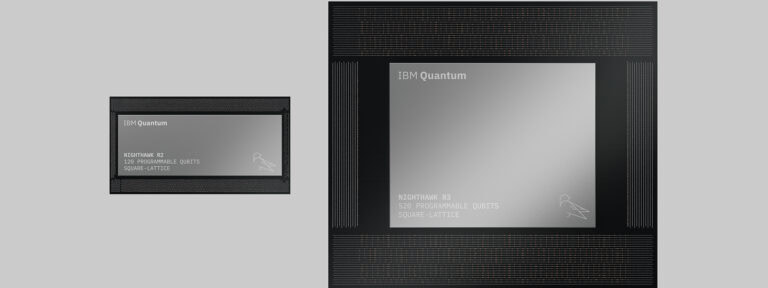
IBM has announced Quantum Nighthawk r3, a processor designed to perform 10,000 quantum operations on 520 qubits. By 2027, the company plans to combine two of these chips into a single system with 1,040 qubits.
The new processor builds on the same architecture as the Nighthawk r2, which IBM introduced in September. The r3 has 2,034 physical qubits, 520 of which are programmable. It retains the r2’s square-lattice design and fast operations. A new feature is ten chip-to-chip connections, called “l-couplers” by IBM, that allow processors to link together.
Why the focus on speed? A quantum computer delivers its answer in samples: each run of a circuit yields a single result. Applications increasingly require thousands of operations on around 100 qubits or more, resulting in millions to billions of samples. “Useful quantum computing hinges on whether results can be delivered with accuracy and speed, both are fundamental,” says Jay Gambetta, Director of IBM Research.
Nighthawk r2 is already running billions of circuits
The r2 achieves up to 100,000 samples per second and supports more than 7,500 operations on 120 qubits. This is largely due to a fast qubit reset, which significantly shortens the time between circuit runs. Customers and partners have now executed 34 billion circuits on it, with performance gains of up to 19 times.
Here are a few examples. E.ON saw a 15-fold speedup in quantum machine learning for optimizing the power grid. An experiment with Oak Ridge National Laboratory on magnetic materials ran 12 times faster than it had previously on IBM Quantum Heron. And a simulation with Algorithmiq ran 8 times faster, while classical tensor network methods are estimated to require 240 times more memory to simulate the new circuits with the same accuracy.
IBM has already demonstrated two building blocks this year for linking processors. Nighthawk r1 chips were connected using four L-couplers, achieving 99.3 percent fidelity in the transfer of quantum states. The target is 99.9 percent. Additionally, in August, IBM connected two cryogenic modules into a single system for the first time, which reached temperatures below 15 millikelvin within five days.
Classical computing power in the platform
Furthermore, IBM is bringing together classical HPC and quantum computing in a single managed environment on the IBM Quantum Platform. Users can link quantum workflows to their laptop, a supercomputer, or the platform’s new HPC resources. IBM and RIKEN were thus able to execute their sample-based quantum diagonalization workflow five times faster, with 100 times more calculations. Cleveland Clinic and RIKEN processed 608 million samples, 33 times faster than without automation.
For error correction research, the platform also offers pulse-level control. Additionally, IBM, together with Oak Ridge National Laboratory and AMD, deployed a Nighthawk physically alongside ORNL’s Umbra HPC system, which runs on AMD Instinct MI355X GPUs and fifth-generation EPYC CPUs.