
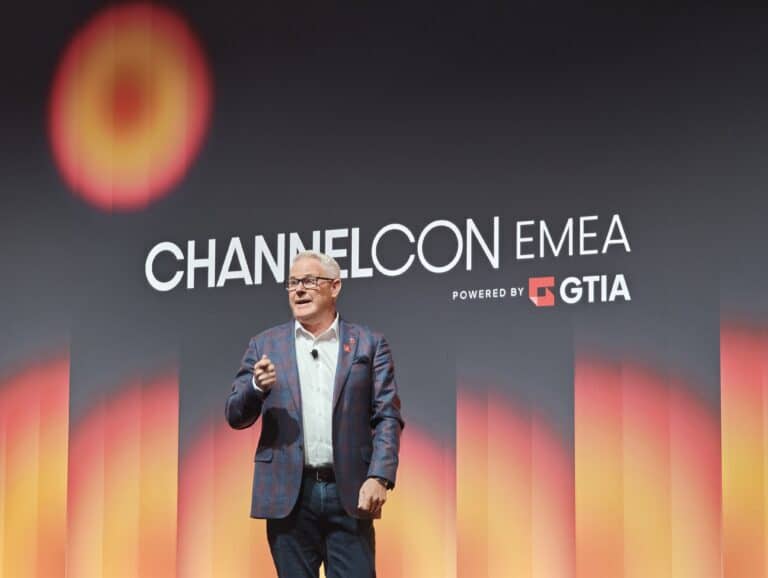
The dual nature of AI is evident to IT service providers. They see the growing threats and the extra work this entails, but also the growth opportunities to generate more revenue from security. This is according to research by the Global Technology Industry Association (GTIA). We spoke with GTIA CEO Dan Wensley about this.
Such growth opportunities are rare these days. IT service providers/MSPs operate in a mature market with a large number of competitors, while recruiting and retaining talent is a major challenge, just as it is elsewhere in the tech world. GTIA conducted two studies that led to this conclusion: the Channel Trends in Cybersecurity study and the Q3 2026 Quarterly Cybersecurity Tracker.
“AI is going to play a critical role in solving [the industry’s challenges] and also creating new ones,” Dan Wensley tells Techzine.
Major security plans
GTIA’s Channel Trends in Cybersecurity study shows that an increasing number of MSPs plan to add more security solutions to their offerings within the next 12 months. While this figure stood at 65 percent in 2025, it has now risen to 76 percent. Nearly 60 percent plan to start providing AI-related security services, with governance, data and model security, and acceptable use policies as priorities. Half of the MSPs surveyed already report revenue growth directly linked to security this year. Identity, security management, and cloud and data solutions are the primary areas of growth.
These opportunities stem from growing challenges. Fifty-one percent of IT providers view AI-generated attacks as one of their customers’ leading concerns. In the UK and Ireland, 47 percent of MSPs see the use of generative AI by cybercriminals as their top cybersecurity concern, up from 37 percent in 2025.
Nevertheless, MSPs and their customers still have some basic groundwork to do. For example, 42 percent of these service providers have MFA enabled on all critical systems for more than half of their customers. Thirty-five percent use immutable, air-gapped backups. This, too, is a fundamental requirement for a strong cybersecurity policy, aside from the fact that it is also necessary to counter AI-driven threats.
According to Wensley, that work is far from done. “MSPs have to take it to heart, have to understand it, and have to go there. […] We’ve been talking about cyber for a long time. We’re not done there. We’re in our infancy still in cyber as AI has come, that wave has come over our heads. But cyber is vitally important. We have a lot of work still to do in that area.”
It’s not a budget issue
Although budgets are tight and are often blamed for undesirable policies, that’s not the case here. Three-quarters of MSPs say customers are more willing to pay as security costs rise. Attackers’ increasing use of AI is the most frequently cited reason customers give for increasing security spending, reported by 45 percent of MSPs. And 87 percent gained a customer thanks to their security offerings, while 21 percent lost one following an incident. Security is thus becoming an increasingly decisive factor for revenue, an important lesson for MSPs at a time when significant revenue growth is rarely possible.
“Concern about AI is giving providers an opening to help customers make practical security decisions,” summarizes Carolyn April, Vice President of Research and Market Intelligence at GTIA. The full GTIA report will be released later this year.
Also read: Pax8 aims for managed intelligence and an AI OS for MSPs