
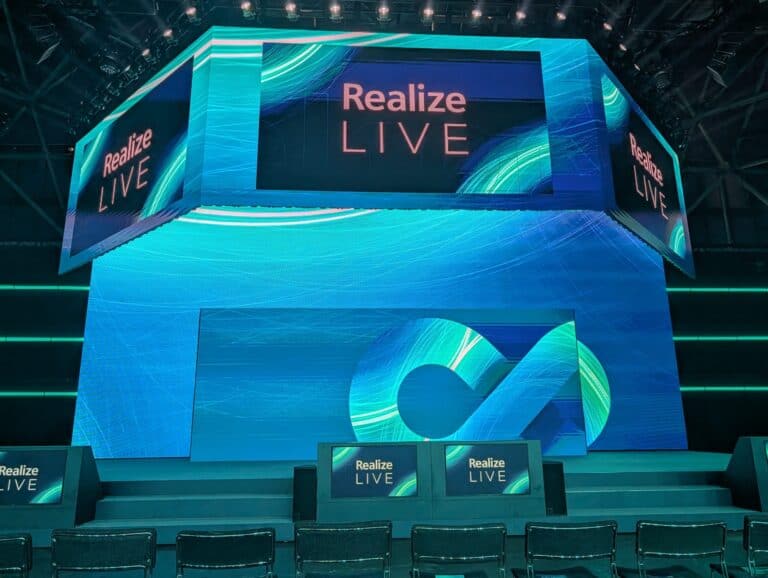
At Realize LIVE Europe 2026 in Amsterdam, high-tech terms are flying left and right. From multiphysics simulations at the ORECA racing team to closed-loop agentic AI in the new partnership between Siemens and IFS. But how do you translate those marketing terms into the down-to-earth reality of the factory floor? We asked Patrick Fokke, Country Manager and Managing Director Benelux at Siemens Digital Industries Software.
Anyone reading Patrick Fokke’s LinkedIn profile will immediately notice that the executive has little time for tech hype. He describes himself as a healthy skeptic when it comes to transformation programs that produce PowerPoint slides rather than results. It’s a refreshing attitude at a large-scale tech event. After all, technology is a means, not an end, Fokke notes matter-of-factly.
Fokke explains that he started at Siemens 15 years ago as an account manager for ASML, his only client at the time. He has now been the country manager for the Benelux region for six years. In that role, he provides operational leadership to a Sales & Services team of about 115 people. As a statutory director, he is responsible for a significantly larger organization of approximately 1,000 employees in the Dutch software division. Following the recent acquisition of Altair, the global parent company has, incidentally, surpassed the 320,000-employee mark.
The hard numbers behind the AI hype
With over twenty years of experience in the industrial tech sector, Fokke has seen complexity and the pace of development increase exponentially. Yet the core of his work has remained unchanged all these years. According to him, it ultimately always comes down to the business case. What does a company want to change, and how does technology contribute to that? Today, everyone is looking at AI, but people sometimes forget that it must serve a specific purpose.
The figures Fokke shares show that the market is struggling with this translation. While in the broader market only 6 percent of companies have actually implemented AI in a scalable and valuable way, the figures among top industrial players are even lower. During the strategic leadership forum at Realize LIVE 2026—a closed-door session with top industry executives—Siemens conducted a live poll. It revealed that only 3 percent of the companies present have rolled out AI in a scalable way that truly contributes to their bottom line. A very small percentage, Fokke concludes. The rest recognize the benefits but are struggling with adoption.
Yet at Siemens, AI is not a distant dream. In design tools such as NX (Design Center), machine learning has been subtly integrated for years through features like the command predictor. Based on historical data, the software predicts with 98 percent accuracy what an engineer’s next action will be and displays that option directly at the cursor. Fokke compares it to chess, where the software anticipates the next moves, which simply speeds up and improves efficiency.
From Le Mans to small and medium-sized businesses

During Realize LIVE, Siemens showcased several case studies. The French motorsports giant ORECA is making a complete switch to Siemens’ Xcelerator portfolio to break down data silos and run multiphysics simulations for its Le Mans cars. At the same time, the Luna Rossa sailing team announced a similar digital transformation. These are impressive showcases, but how do you translate that to an average machine builder in the Benelux who doesn’t have a racing team’s budget?
According to Fokke, the key is to engage in dialogue rather than simply pushing technology. What Siemens learns from ORECA and Luna Rossa about linking data is packaged into what are called “digital threads.” These are predefined roadmaps and best practices tailored to each industry. An average manufacturer, therefore, doesn’t have to reinvent the wheel and can immediately benefit from the lessons learned in elite sports.
Breaking down those data silos, whether it involves aerodynamics and mechanics at ORECA or the new integration between product design and maintenance via IFS is, according to Fokke, rarely a purely technical problem. Forcing teams to step off their own little islands is a cultural shift, he argues. Siemens therefore trains its own teams to dig deep into the customer’s organization, because simply installing a tool just doesn’t work.
No room for hallucinations
A key topic during the event is the rise of agentic AI. While consumers mainly know AI as a chatbot that occasionally makes up a fact, that’s unacceptable in heavy industry.
Fokke states emphatically that when developing aircraft, you cannot settle for an answer that is “probably” correct. In engineering and manufacturing, the result must be 100 percent accurate. That is why Siemens connects AI-native systems directly to data backbones such as Teamcenter via the new Intelligent Center X architecture. By using graph technology, results are validated based on a single source of truth to prevent hallucinations. According to the CEO, the best results still come from close collaboration between humans and AI. The human touch remains essential, he says.
The European blind spot
When we ask Fokke about the biggest general assumption in the tech sector that he questions, his gaze shifts to the geopolitical stage and the discussion surrounding digital sovereignty. He warns that in Europe and the Benelux region, there is simply too little attention paid to the enormous dependence—particularly on the U.S.—on computing power for AI.
Europe has neither the large AI models nor the large-scale computing capacity under its own control. He calls this paradoxical, because although we have an absolute global player in the Netherlands—ASML—which supplies the machines for the most powerful chips, the massive data centers required for that computing power are not located here. In his view, we as a region really need to be more alert to this.
Focus on depth in the Benelux
This focus on the specific business case is closely linked to Fokke’s market strategy in the Benelux. As stated on his LinkedIn profile: “fewer accounts done properly beats broad coverage done thin.” In practice, Siemens employs a differentiated model for this. Strategic accounts of enormous scale, such as his former client ASML, are served directly by dedicated account teams who visit the client’s premises daily.
The broader Dutch and Belgian market is deliberately covered through a network of specialized partners. These range from resellers to build-and-service partners. They bring specific expertise in areas such as simulation tools or low-code.
According to Fokke, this layered approach is essential. In practice, an industrial company with fifty employees simply prefers to do business with a partner of a comparable size. That’s more convenient than dealing directly with a global corporation employing hundreds of thousands of people.
The task for Monday
Siemens is investing heavily in training models that specifically understand what a 3D model, a bill of materials, or a work instruction is. Precisely because these developments are moving so quickly, Fokke drew a clear conclusion for his own organization after a tour of the exhibition floor.
He recounts how, the day before, he had been walking around with the head of a major aerospace company, who was amazed and surprised to realize that he hadn’t known all these capabilities were already built into the tools they were using. The customer immediately wanted to book a follow-up session for all his engineers.
This led Fokke to an important personal insight. Siemens sometimes falls short of clearly communicating what is already possible. Customers are so focused on the day-to-day operations that they sometimes fail to notice how quickly their standard tools are evolving. His main task for his team in the coming period is therefore to proactively engage with customers and show them how they can already put AI to practical use. But, as Fokke concludes with a smile, referring to his own LinkedIn philosophy, this must always be directly linked to the specific business case. It has to show up on the bottom line of the P&L.