
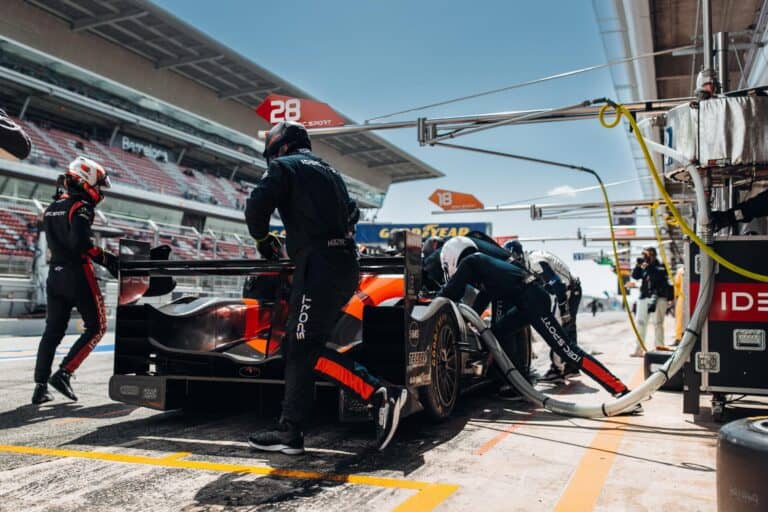
Siemens has announced that the French motorsports giant ORECA Group is making a large-scale transition to the Siemens Xcelerator portfolio. The software will be used to develop high-performance race cars, including the prestigious Le Mans hypercar program with Ford.
With this move, the engineering firm is replacing its outdated, fragmented simulation environment. The primary goal of this migration is to break down data silos by integrating aerodynamic, thermal, and structural simulations into a single digital twin.
In elite sports, the margins for product development are razor-thin, and time-to-market deadlines are relentless. Whereas traditional industrial manufacturers have months or years to validate a design, motorsport designers must iterate within weeks. To achieve that speed without compromising reliability, a “virtual-first” design strategy is essential.
In practice, however, ORECA ran up against the limits of its existing IT landscape. Separate legacy tools for different disciplines created friction in data transfer between engineering teams, Siemens reported at Realize LIVE Europe 2026, where Techzine is in attendance.
How does Siemens Xcelerator address this from a technical standpoint?
At ORECA, the migration to the Xcelerator platform focuses on implementing specific software suites within the Simcenter portfolio. The benefit lies not only in faster computation times, but purely in what is known as multiphysics integration. Previously, aerodynamic simulations for airflow, thermal simulations for heat management, and mechanical calculations for braking systems were often performed in sequential, isolated steps.
With the introduction of Simcenter STAR-CCM+, ORECA is transitioning to coupled multiphysics simulations. The software simulates the interaction among all these forces simultaneously within a single computational model. For example, if the airflow changes, the system immediately calculates the impact on brake cooling and the thermal load on the surrounding bodywork. This approach drastically reduces development time and eliminates the need to manually convert data between different specialized teams.
In addition, ORECA uses Simcenter Optistruct for the structural optimization of carbon fiber. Designing these composite materials is complex because the orientation and exact number of carbon layers determine the stiffness and the final weight. Optistruct uses algorithms to calculate the mathematically optimal layering based on the simulated physical forces from the aerodynamic phase.
As a result, engineers need to rely less on trial and error to find the perfect balance between weight savings and structural integrity under extreme G-forces. By integrating all these tools within a Digital Twin environment, ORECA is establishing a single source of truth in which changes to the aerodynamics are immediately reflected in the structural calculations.
Top-level maritime sports are also going digital
The widespread demand for this level of integrated industry software is evident in Siemens’ simultaneous announcement regarding the Luna Rossa sailing team. This team, preparing for the 38th America’s Cup, is also significantly expanding its digital engineering ecosystem on the Siemens Xcelerator platform. Although the dynamics on the water are, of course, different from those on the road, the underlying IT challenges are identical. Managing extreme mechanical complexity under time pressure is central to both cases.
Luna Rossa is actually taking it a step further than ORECA across the entire IT stack. They are not only integrating simulation software for aerodynamics and mechatronics; they are also linking it directly to their application management via Polarion ALM (Application Lifecycle Management). This ensures full traceability within the development process. Every specific design requirement, test phase, and software change in the onboard systems is thus directly linked to the validation data from the digital simulations.
Enterprise lesson: from elite sports to mainstream industry
For IT decision-makers outside of motorsports, ORECA’s case clearly demonstrates the direction in which modern Product Lifecycle Management and engineering software are heading. The era of standalone CAD and CFD tools is definitively over, and the real value lies in platform-based integration of multidisciplinary data within a continuous digital chain. What today delivers a fraction-of-a-second advantage at Le Mans or during the America’s Cup eventually trickles down to the mainstream automotive and high-tech manufacturing industries. This shortens the time-to-market for complex, sustainable products.