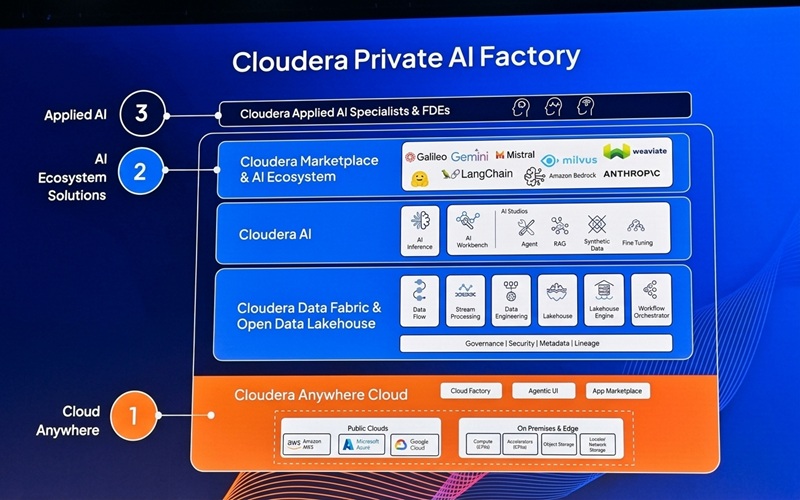

Cloudera used its EVOLVE26 conference in New York this week to explain how the company is continuing to develop its platform and software tools. The company is known for its work spanning data ingestion, data storage, data processing, data analytics and data visualisation. Built on open source distributed computing and big data frameworks, the Cloudera platform provides scalable storage and parallel processing. So what are the prime drivers in this space and what do we need to think about next?
Cloudera’s interest now gravitates toward how organisations can ensure AI services get the high-quality, eminently accessible data delivery they need to function. The company marries this mission with its work to deliver strategies for optimising hybrid and multi-cloud environments to support AI workloads while maintaining security, compliance and cost efficiency.
Central to the organisation’s technology stack is Cloudera Anywhere Cloud, which executes on data across public clouds, private datacentres and sovereign infrastructures i.e. those overseen and managed entirely under local national laws. The service is built to operate standalone or complement existing massive data lakes and deliver a unified cloud experience wherever data resides.
Push-button simplicity & cloud-native agility
Cloudera Anywhere Cloud is built to allow software engineering and wider Ops teams to automate workflows and launch advanced AI capabilities directly against their proprietary data estates without moving sensitive assets. The tagline here is so-called “push-button simplicity and cloud-native agility” on enterprise data.
Featuring a simpler, “outcome-driven interface” these days, Cloudera Anywhere Cloud is built on a modular architecture that allows users to deploy, govern, and scale independent AI and data services across public clouds, sovereign infrastructure, and private datacentres.
Cloudera this year introduced native GPU acceleration for Apache Spark 4.1 in Cloudera Data Engineering, enabled by the Nvidia CUDA-X library, cuDF. The Nvidia cuDF plug-in for Apache Spark will support the Cloudera Anywhere Cloud, so that teams can run Spark workloads without rewriting PySpark or SQL code.
89% are rethinking AI use cases
Cloudera used its EVOLVE26 event itself to showcase and explain its 2026 State of Enterprise AI report, which suggests rising costs, concerns over governance demands, and sovereignty requirements, all of which are forcing enterprises to rethink how and where they run AI.
The company’s State of Enterprise AI 2026: The New Rules of Scale is a new study examining how enterprises are navigating the cost, control, and flexibility required to sustain AI at scale.
Based on a survey commissioned by Cloudera and fielded by Wakefield Research of 1,500 IT leaders and decision-makers at the director level or above across nine markets in the Americas, EMEA, and APAC in September 2026, the report finds that the rules of enterprise AI are changing as rising costs, governance demands, and sovereignty requirements reshape how and where organisations run AI.
Nearly nine in 10 (89%) respondents have already limited or redesigned AI use cases because of rising token consumption, while 84% say data residency, sovereignty, or jurisdiction-specific requirements influence where AI workloads are placed, underscoring the need for greater flexibility and control as enterprises scale AI.
Among the report’s key findings:
- AI in production requires adjustment: 98% have pulled back an AI deployment due to failure, hallucinations, or unexpected behaviour.
- Governance is constraining scale: 75% say governance and compliance limit AI scale, while 55% report faster-than-expected governance costs.
- AI costs are reshaping strategy: 45% have moved AI workloads in response to higher or more volatile costs.
- Sovereignty is shaping workload placement: 84% say residency or sovereignty requirements influence where AI runs, and 58% say moving workloads requires moderate or major redesign.
“Scale is exposing a new reality for enterprise AI: what works today may not make economic or operational sense tomorrow,” said Brian Martin, CTO of applied AI at Cloudera. “Costs change, models evolve, regulations shift, and the right place to run a workload changes with them. Leaders need an AI strategy built for that reality, one that gives them the freedom to adapt without giving up control of their data, governance, or spend.”
The findings also reveal what may be a growing focus on the foundations required for long-term AI success. If given the opportunity to restart their AI journey, 49% of respondents say they would strengthen governance from the beginning, 46% would invest in data quality earlier, and 45% would modernise infrastructure sooner. Another 45% would invest more in employee training.
This need for adaptability is making flexibility across environments increasingly important. Organisations cite resilience (42%), sovereignty and residency requirements (38%), cost reduction (38%), and proximity to data (37%) among the leading reasons for operating AI workloads across multiple environments.
Cloudera enables organisations to bring AI to their data anywhere it lives while maintaining consistent governance and control across environments. By bringing compute to governed data rather than requiring enterprises to move data to AI, organisations can choose where workloads run based on changing cost, performance, sovereignty, and business requirements while maintaining control across the AI lifecycle.
The Cloudera R&D “journey”
Wim Stoop, Cloudera senior product manager, kicked off the EVOLVE26 keynote with a thank you to the sponsors… quickly moving on to welcome Charles Sansbury, Cloudera chief executive officer. Sansbury said that the company has been on something of a journey over the last couple of years to modernise the platform and also move towards a more customer-focused user experience. Having spent over a billion dollars over the last few years, the Cloudera platform Kona release is said to be the most user-focused release of the company’s key platform technologies.
“We thought about how to bring that cloud-like experience that customers want (with Cloudera Anywhere Cloud) when working with data in any hyperscaler. We know that customers are driving the cutting edge of AI technologies – and we know that customers today focus more on the use case than the technology stack,” said Sansbury.
He noted that Cloudera has developed a subset of use cases that it packages for reusability across hybrid environments.
Hybrid is the end-state environment
“Hybrid is the end-state environment,” underlined Sansbury. He explained that both private and sovereign AI are both now imperatives… and so Cloudera has partnered closely with open-weight model company Mistral to extend its platform in terms of key agentic abilities.
Telling attendees that data gravity needs to be accounted for, Sansbury said that Cloudera Anywhere Cloud is “not just another cloud product”, but it is a total orchestration platform that provides a central control plane that operates across any data, any cloud and any AI. Sansbury said that it’s all about providing performance, scalability, security and usability. The message here is also all about data management and governance for an organisation’s entire data estate.
“This is probably the most NEW technology that we have delivered to customers in the last five years,” concluded Sansbury.
Product specialists
Leo Brunnick, chief product officer and Sergio Gago, chief technology officer, then took the stage for a well-rehearsed double act, saying that they had an “audacious goal” in terms of what they wanted to present for the EVOLVE26 conference this year. “The Kona release is the arc of four or five years of what customers have been asking for; it is also the most stable and performant technology that Cloudera has ever released to market,” said the pair, speaking in unison.
Looking at the increased “optionality”, Cloudera now works with any S3a-compatible object store (an S3a-compatible object store is a storage system implementing the Amazon S3 API, allowing big data frameworks like Hadoop to seamlessly read and write data) and the company can do “backwards-compatible releases” when security CVE developments call for it.
The Cloudera AI Inference Service joins Cloudera Agent Studio so that customers can “expose their data lake” to any agentic services they want.
- Cloudera AI Inference Service is a production-grade platform for deploying, scaling, and managing predictive and generative AI models securely on enterprise data.
- Cloudera Agent Studio is a low-code to high-code platform for building, testing, and deploying multi-agent AI workflows and autonomous enterprise applications securely on corporate data.
- Cloudera Lakehouse Optimizer is a managed service that automates Apache Iceberg table maintenance and compaction to accelerate analytical queries and reduce storage costs.
From 60 days to 60 minutes
The platform delivers a hybrid architecture running the same code, security, governance, and pre-integrated AI-infused services anywhere. Built modularly to keep pace with innovation, it offers extensible marketplace patterns that accelerate ROI and drive fast time to value – and it cuts Cloudera deployment times from 60 days to 60 minutes. Designed with an agentic-first approach to increase data democracy, it operates standalone or directly alongside Cloudera to fully use existing data lake investments.
Taking over from this extended product session (in fairness, CEO Sansbury did say that there was a lot of product news), Abhas Ricky, chief business officer and GM of applied AI took the stage. Ricky started off with the Cloudera vision for the private AI factory.
Ricky framed private AI as a foundation for enterprise analytics and AI applications, with a focus on how Cloudera is delivering its blueprint investments, and the capabilities and teams it is building. He emphasised five principles:
A consistent experience across environments; high-fidelity context for agents and models; control over economics, deployment form, and workloads; choice across model providers and technology layers; and capabilities developed with customers and partners.
1. Standard Business Process Integration: AI initiatives must be embedded directly into existing enterprise workflows and core operations rather than treated as standalone side projects, ensuring immediate, measurable business outcomes and long-term scalability.
2. Future-Proof & Scalable Infrastructure: AI platforms require scalable data pipelines, flexible architecture, and multi-cloud capabilities designed from the outset to support growing workloads, autonomous agentic reasoning, and complex inference demands.
3. Trusted Data Foundation & Governance: Models are only as reliable as the data that feeds them; organisations must enforce strict data lineage, security, and quality controls to maintain context, reduce hallucination, and ensure compliance.
4. Model Flexibility & Choice: Enterprise deployment relies on matching the right model – whether open-source, proprietary, large language, or specialised small language models – to specific execution and cost constraints without vendor lock-in.
5. Closed-Loop Execution (“Data-to-Action”): The AI factory must complete the cycle from raw data ingestion to automated, real-time action, closing the loop between intelligence generation and real-world operational execution.
Data fabric, governance & locality
“Across warehousing, machine learning, ingestion, and other data journeys, the goal is to provide governance, security, and lineage wherever data resides,” said Ricky.
He welcomed Mistral chief revenue officer Marjorie Janiewicz. This September, Cloudera and Mistral signed an agreement that sees the companies working together to combine Cloudera’s hybrid data and AI platform with Mistral’s sovereign AI models to give enterprises a secure path to build, customise, and run AI using their own private data. The collaboration will enable organisations to bring intelligence directly to their data across cloud, on-premises, edge, sovereign, and air-gapped environments – without requiring sensitive information to leave their control.
“Together with Mistral, we are giving enterprises the ability to run AI where their data lives, customise it with their own intellectual property, and maintain control over their data, infrastructure, and economics. That combination of intelligence and control is essential to moving AI from experimentation into production,” said Ricky.
Other speakers at the event included Brian Rosso, chief revenue officer and Noel Yuhanna, VP, principal analyst, Forrester.
What this means for developers
As always, Techzine Global wants to take this narrative on board and ask what this means for developers. Software engineers and data engineering teams looking at the developments here will now need to think beyond model selection and inference performance. Why? Because AI applications depend on governed, accessible data, but the infrastructure hosting that data may be subject to changing costs, jurisdictional restrictions and security requirements.
A platform that supports workloads across public cloud, private datacentres and sovereign environments can give teams more deployment options without forcing them to rebuild every application around a new location… and (no prizes for guessing) that pretty much sums up what Cloudera is working to deliver. The company’s support for GPU acceleration in Apache Spark 4.1 also points to an effort to improve processing performance while preserving existing PySpark and SQL code.
The real test in terms of software application development will now (arguably) be how consistently workloads, governance policies and operational controls transfer between environments.