
Skip to content
Techzine Global
  • Home
  • Topstories
  • Topics
    • Analytics
    • Applications
    • Collaboration
    • Data Management
    • Devices
    • Devops
    • Infrastructure
    • Privacy & Compliance
    • Security
  • Insights
    • All Insights
    • Agentic AI
    • Analytics
    • Cloud ERP
    • Generative AI
    • IT in Retail
    • NIS2
    • RSAC 2025 Conference
    • Security Platforms
    • SentinelOne
  • More
    • Become a partner
    • About us
    • Contact us
    • Terms and conditions
    • Privacy Policy
  • Techzine Global
  • Techzine Netherlands
  • Techzine Belgium
  • Techzine TV
  • ICTMagazine Netherlands
  • ICTMagazine Belgium
Techzine » Blogs » Infrastructure » Pure’s FlashBlade//EXA should solve storage bottlenecks in AI and HPC
4 min Infrastructure

Pure’s FlashBlade//EXA should solve storage bottlenecks in AI and HPC

"Storage is accelerating the pace of large-scale HPC and AI evolution."

Insight: Storage

Sander AlmekindersMarch 11, 2025 3:00 pmMarch 31, 2025
Pure’s FlashBlade//EXA should solve storage bottlenecks in AI and HPC

Traditional storage environments are not necessarily created or targeted to support modern AI and/or HPC workloads. Indeed, they can cause precious GPU cycles to be lost simply because the storage can’t keep up. Pure Storage aims to put an end to this with the announcement of FlashBlade//EXA.

With FlashBlade//EXA, Pure’s scale-out platform gets a third member, in addition to FlashBlade//S and FlashBlade//E. Pure is apparently keen to make the high performance of the new offering clear. It could have chosen to come out with a FlashBlade//X in parallel with the FlashArray naming convention (i.e. there is a FlashArray//X, besides FlashArray//S and FlashArray//E). It clearly chose otherwise. In any case, it is now clear that this version of FlashBlade is very powerful, given the rather explicit reference to exascale computing.

FlashBlade//EXA is focused on AI Factories

If we restrict ourselves to AI environments for a moment, they can be roughly divided into three categories. At the top are hyperscalers, at the bottom there’s enterprise AI. In the middle are the use cases that fall under the umbrella of the AI Factory. Examples include HPC labs and research centers, GPU clouds and highly sophisticated large enterprises. That’s the category Pure Storage is targeting with FlashBlade//EXA.

In a briefing on this news we received from Marco Bal, Principal Systems Engineer Benelux at Pure, he puts some numbers on the different categories for convenience. Looking purely at the throughput of systems in those environments, enterprise AI environments are fine with speeds of up to 1 terabytes per second. Hyperscalers, on the other hand, need more than 50 terabytes per second. AI Factories are in between those two, so between 1 and 50 terabytes per second.
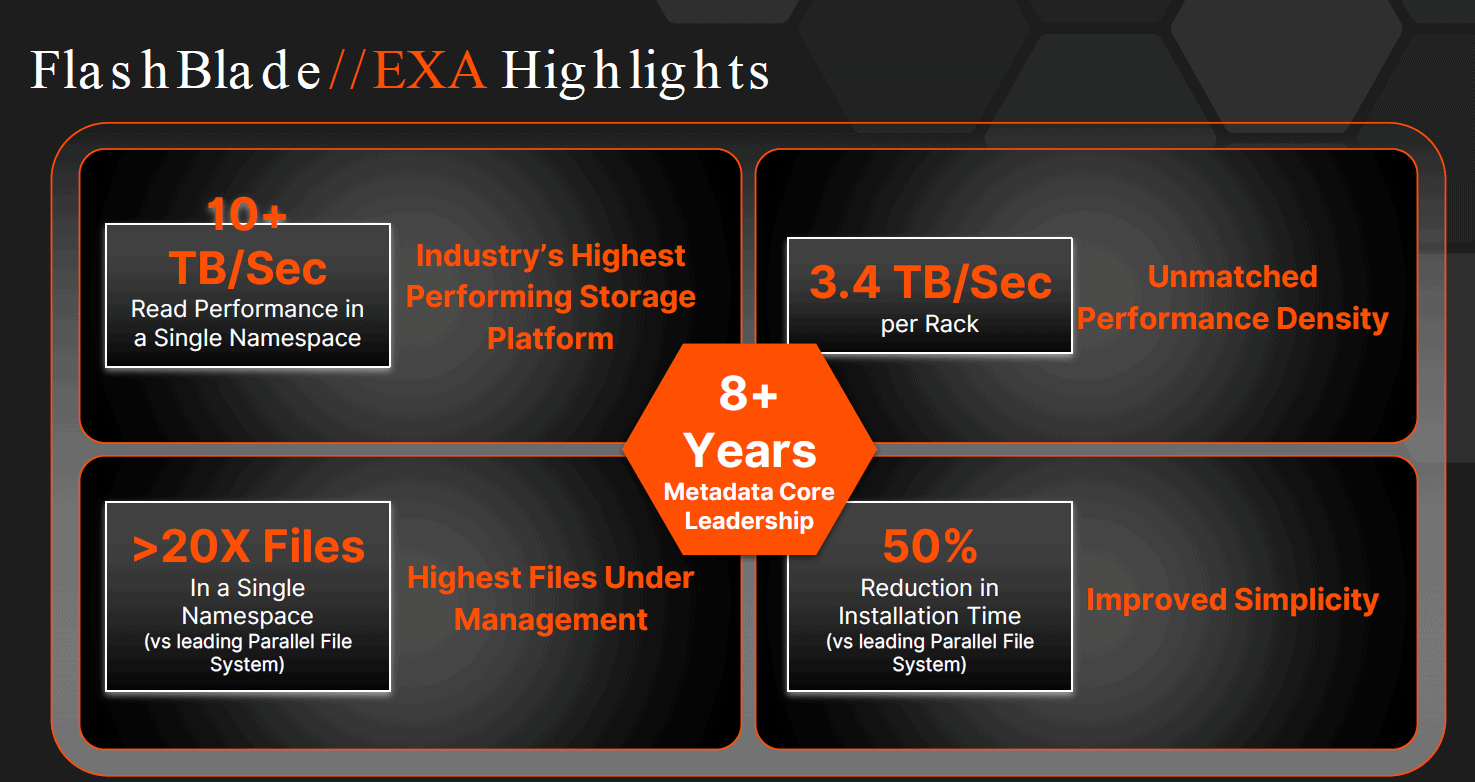
Infographic met de kenmerken van FlashBlade//EXA: 10+ TB/sec. prestaties, 3,4 TB/sec. per rack, 20x bestanden in een naamruimte, 8+ jaar leiderschap in metadata, 50% kortere installatietijd.

Pure claims at launch that FlashBlade//EXA is the best-performing storage platform on the market today. It can handle 10 terabytes per second in a single namespace. Per rack, this equates to 3.4 terabytes per second. Now, we don’t have all the performance figures of all vendors handy, and Pure will most likely also have chosen the most favorable outcomes, but 10 TB/s is definitely a rather impressive performance. Mind you, these are initial test results. However, Pure expects to continue to live up to them.

FlashBlade//EXA is disaggregated and multi-modal

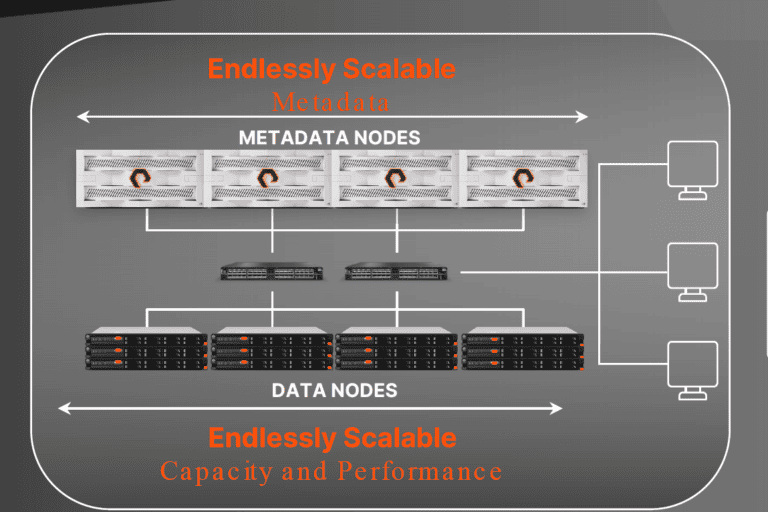
Looking briefly under the hood of Pure’s new FlashBlade//EXA platform, we see a modern storage architecture there. Today, that means, first of all, that it is disaggregated. That is, metadata and “real” data can communicate with the compute department of an AI stack separately from each other. Metadata and data can then also scale separately from each other. In theory, this should provide virtually infinite scalability.
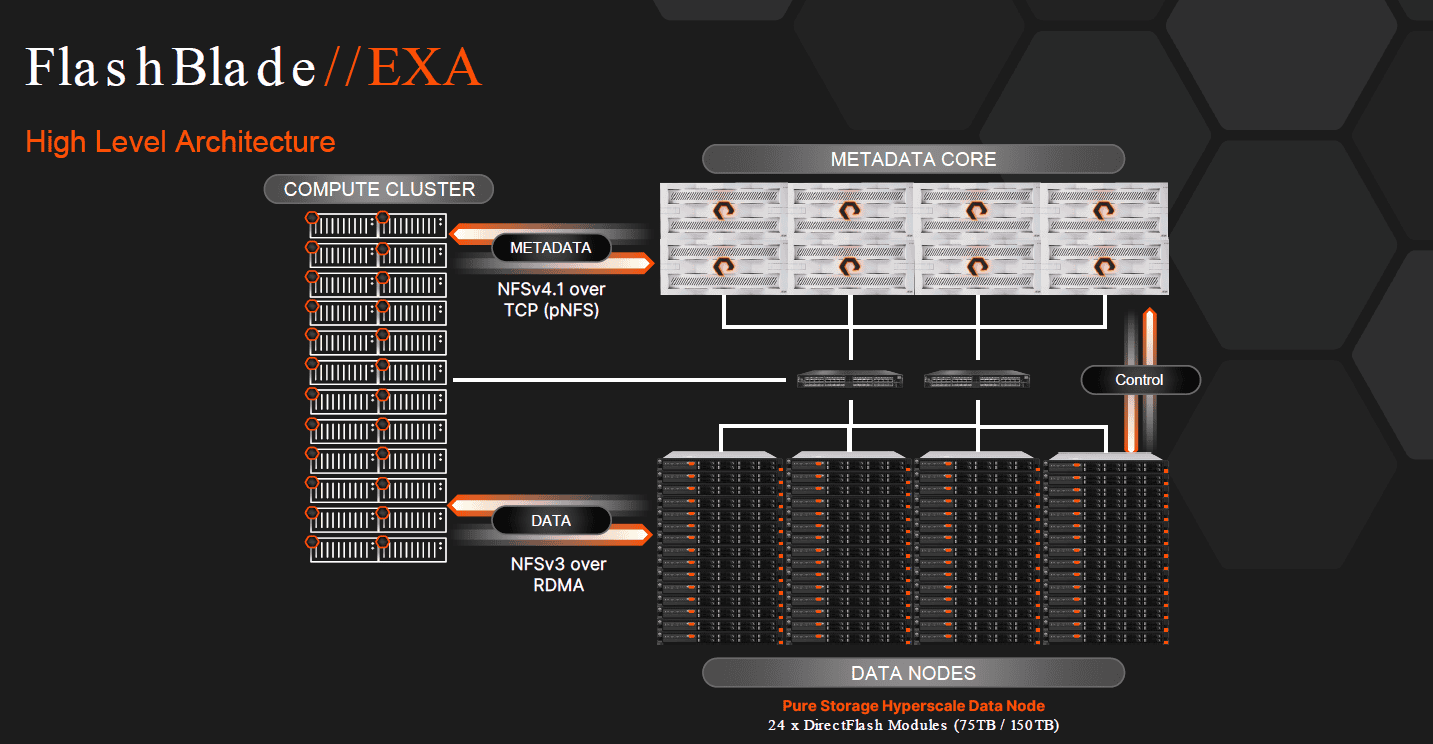
FlashBlade EXA-architectuurdiagram op hoog niveau met de verbindingen tussen het rekencluster, de metadatakern en datanodes, met routes voor metadata en data via NFSv4.1 via TCP en RDMA.

FlashBlade//EXA is in fact the so-called Metadata Core of the architecture. Pure has fully optimized FlashBlade to handle metadata massively parallelized. The other storage component, the Data Node, where the actual data resides, consists of standard off-the-shelf nodes. Bal does add during our conversation that after general availability of FlashBlade//EXA, Pure plans to replace these with Pure’s Hyperscale Data Nodes, DFMs (Direct-Flash Modules) of 75 or 150 TB.
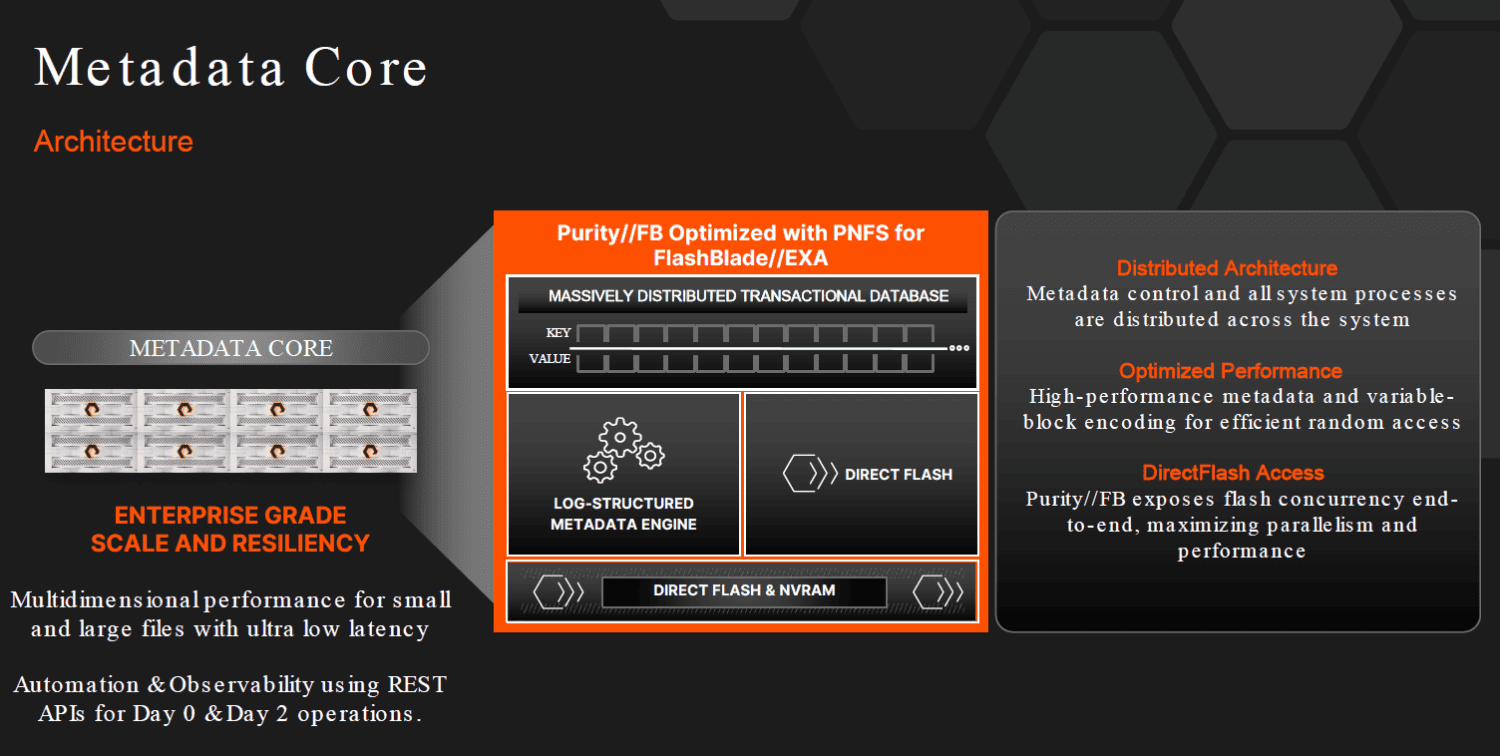
Infographic met de titel 'Metadata Core Architecture' met componenten als een log-gestructureerde metadata-engine, direct flash en gedistribueerde architectuur voor prestaties en veerkracht.

Besides disaggregated, it is also important to note that FlashBlade//EXA is multi-modal and multi-dimensional. That means that it is suitable for all types of data, where it doesn’t matter if the files are small or large, or it has to handle random or sequential data. This is important because different types of AI use different types and formats.

All of this, combined with the Purity operating system that also obviously runs on this, should make possible the claim from the subhead at the top of this story, made by Pure-CTO Rob Lee. Of course, whether storage will actually set the pace for AI and HPC innovation remains to be seen. There will undoubtedly be some marketing in that statement as well. In itself, that doesn’t really matter. As long as FlashBlade//EXA can keep up with the GPUs and the network, that means that storage is no longer an inhibitor. If Pure can deliver on that, it has already succeeded.

FlashBlade//EXA will most likely become generally available in the summer of 2025.

Also read: R&D is the lifeblood of Pure: a peek behind the curtains

Tags:

AI / AI Factory / disaggregated storage / FlashBlade//EXA / HPC / metadata / Pure Storage

"*" indicates required fields

This field is for validation purposes and should be left unchanged.

Stay tuned, subscribe!

Nieuwsbrieven*

Related

Pure Storage and Cisco unveil FlashStack for enterprise AI

Pure Storage unifies data in Enterprise Data Cloud for greater control over AI

Pure Storage further expands Enterprise Data Cloud

Pure Storage promises ‘one-click’ AI deployment with GenAI Pod

Editor picks

Workday is well prepared for the EU AI Act, who will follow?

Many organizations are facing a challenging deadline on August 2. The...

VTEX aims to conquer the e-commerce market with AI Agents

At VTEX Day 2026 in São Paulo, VTEX presented its three products for...

OpenSearch is enterprise-ready with long-term support and version 3.6

The OpenSearch Software Foundation has announced a long-term support ...

The European cloud of the future is built using real containers

MISD project aims to create modular, sustainable data centers

Techzine.tv

Why only 25% of teams are ready for the Cyber Resilience Act

Why only 25% of teams are ready for the Cyber Resilience Act

Your network isn't ready for AI: Here's what needs to change

Your network isn't ready for AI: Here's what needs to change

How Ansible becomes the execution layer for agentic AI

How Ansible becomes the execution layer for agentic AI

How JFrog secures binaries in the age of AI coding assistants

How JFrog secures binaries in the age of AI coding assistants

Read more on Infrastructure

SUSE AI Factory brings coherence to AI ideals
Top story

SUSE AI Factory brings coherence to AI ideals

The step from AI pilots to production has proven to a yawning chasm. To address this, SUSE can't get away wit...

Erik van Klinken 17 hours ago
The European cloud of the future is built using real containers
Top story

The European cloud of the future is built using real containers

MISD project aims to create modular, sustainable data centers

Sander Almekinders 12 hours ago
95% of GPU capacity goes unused in Kubernetes clusters

95% of GPU capacity goes unused in Kubernetes clusters

Based on data from tens of thousands of clusters, GPU usage averages just 5 percent, CPU usage stands at 8 pe...

Berry Zwets 10 hours ago
SUSE underestimated demand for VMware alternative, CEO admits

SUSE underestimated demand for VMware alternative, CEO admits

SUSE CEO Dirk-Peter van Leeuwen admitted during SUSECON 2026 that his company initially underestimated the ur...

Erik van Klinken 11 hours ago

Expert Talks

Anthropic’s Mythos preview: why the human layer matters more, not less

Anthropic’s Mythos preview: why the human layer matters more, not less

Anthropic has announced Anthropic’s Mythos Preview, a frontier mode...

Why SAST is growing in importance in the age of AI-generated source code

Why SAST is growing in importance in the age of AI-generated source code

Vibe coding is rising astonishingly quickly, but even developers who ...

Infosecurity Europe announces first wave of keynote speakers for 2026

Infosecurity Europe, the most influential information security event...

Better connected business technology is essential for prosperity in the Netherlands 

According to PwC, the Netherlands ranks fourth in Europe for producin...

Tech calendar

Southeast Asia AI Application Summit 2026

April 23, 2026 Bangkok

SAS Innovate 2026

April 27, 2026 Grapevine

Team '26

May 5, 2026 Anaheim

Knowledge 26

May 5, 2026 Las Vegas

GISEC GLOBAL 2026

May 5, 2026 DUBAI

Red Hat Summit

May 11, 2026 Atlanta

Whitepapers

Experience Synology’s latest enterprise backup solution

Experience Synology’s latest enterprise backup solution

How do you ensure your company data is both secure and quickly recove...

How to choose the right Enterprise Linux platform?

How to choose the right Enterprise Linux platform?

"A Buyer's Guide to Enterprise Linux" comprehensively analyzes the mo...

Enhance your data protection strategy for 2025

The Data Protection Guide 2025 explores the essential strategies and...

Strengthen your cybersecurity with DNS best practices

The white paper "DNS Best Practices" by Infoblox presents essential g...

Techzine Global

Techzine focusses on IT professionals and business decision makers by publishing the latest IT news and background stories. The goal is to help IT professionals get acquainted with new innovative products and services, but also to offer in-depth information to help them understand products and services better.

Follow us

Twitter
LinkedIn
YouTube

© 2026 Dolphin Publications B.V.
All rights reserved.

Techzine Service

  • Become a partner
  • Advertising
  • About Us
  • Contact
  • Terms & Conditions
  • Privacy Statement