
Kubernetes cluster sprawl and underutilized GPUs are costing organizations millions of dollars. vCluster addresses both challenges with a virtualization layer that sits on top of Kubernetes, enabling teams to maximize hardware efficiency while maintaining strong isolation and security.
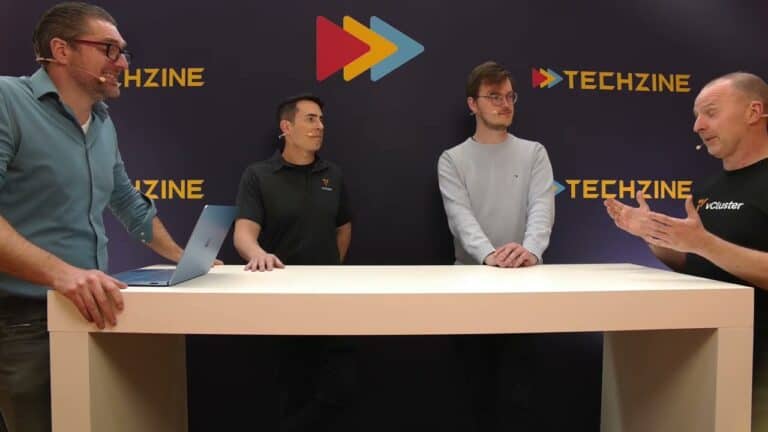
At KubeCon and CloudNativeCon Europe, Tom Brightbill, head of product at vCluster, and Laurie Maclachlan, head of international sales, explained how their platform helps organizations get more value from expensive GPU infrastructure. It does this by virtualizing Kubernetes clusters. The platform runs workloads and control planes as pods on a host cluster, providing teams with completely isolated cluster experiences while sharing underlying infrastructure. This approach delivers significant efficiency gains, particularly important for GPU-based workloads where hardware costs are substantial. The platform offers two main deployment models. In shared clusters, vCluster runs both workloads and the control plane as pods on the host, giving users a completely isolated cluster view. Alternatively, organizations can run only the control plane virtually while joining dedicated worker nodes to individual tenant clusters. Both approaches reduce operational overhead and consolidate infrastructure requirements.
Watch more videos from KubeCon & CloudNativeCon Europe
The ability to spin clusters up and down quickly provides flexibility for dynamic workloads. Teams can allocate different resource limits that work with GPU schedulers, ensuring maximum utilization without idle resources. When GPU capacity sits unused, organizations lose money every second, making efficient orchestration critical for return on investment.
Bare metal provisioning for rapid deployment
vCluster recently moved down the stack to address bare metal provisioning challenges. The platform helps customers provision bare metal machines, join them to clusters, and reprovision those machines for other clusters as needed. This capability is particularly valuable for NeoCloud providers and sovereign cloud operators who need to quickly transform racks of GPUs into managed services.
Brightbill acknowledges that bare-metal provisioning requires in-depth knowledge of PXE booting and ISO loading, which is not always easy. The momentum behind sovereign clouds and AI factories has created renewed demand for these capabilities. vCluster provides Kubernetes-native tools to automate the complexity, allowing teams to focus on higher-value services rather than low-level infrastructure concerns.
The speed advantage is substantial. When NeoCloud providers receive shipments of GPU hardware worth hundreds of thousands or millions of euros, they need to get them up and running as quickly as possible. vCluster enables these organizations to move from rack installation to managed service offerings in dramatically compressed timeframes.
Cost savings and utilization improvements
While specific cost savings are use-case dependent, vCluster provides value across multiple dimensions. Direct utilization improvements come from better bin packing and the ability to shut down development clusters during off-hours. If all development clusters shut down on weekends, organizations can immediately reclaim 2/7 of their costs. Beyond raw utilization metrics, vCluster delivers compliance benefits, speed advantages, and operational cost savings. The ability to reduce cluster sprawl and consolidate infrastructure provides FinOps benefits, though Maclachlan emphasizes that vCluster addresses architectural challenges at a first principles level rather than functioning purely as a financial optimization tool.
Security through isolation
Security is enhanced rather than compromised by vCluster’s virtualization approach. The platform provides stronger isolation compared to traditional Kubernetes namespacing, which is critical for multi-tenanted architectures and sovereign cloud discussions. Additional security measures are available through vNodes in shared node environments. vCluster is effectively a Kubernetes distribution, providing access to all native Kubernetes security capabilities. The fact that the platform packs more workloads onto infrastructure or virtualizes clusters does not create additional security risk, the isolation model actually provides better security than namespace-based separation.
Developer experience and automation
Despite the underlying complexity, vCluster prioritizes developer experience and ease of use. The platform uses CRDs and Kubernetes-native language that developers already understand, reducing the learning curve and accelerating adoption. Teams can deploy monitoring tools like Prometheus or OpenTelemetry from the platform and integrate with on-premises PV provisioners.
The focus on speed extends beyond initial deployment to ongoing operations. For internal developer platforms, vCluster provides an EKS-like experience that enables rapid iteration. Developers can spin up ephemeral clusters for testing, regression testing, and microservice integration without waiting for platform teams to provision resources manually.
Serving NeoClouds, large enterprises and sovereign clouds
vCluster serves a genuinely diverse customer base spanning multiple segments. NeoCloud providers building greenfield GPU infrastructure represent one major category. These organizations are moving at an incredible pace to monetize scarce GPU capacity, requiring solutions that can keep up. Hundreds of new NeoCloud providers are emerging. Many receive substantial funding but lack infrastructure capabilities. They are acquiring real estate, securing power, and implementing liquid cooling, often coming from rack-and-stack hardware backgrounds rather than software expertise. Maclachlan notes that the team is sometimes amazed by daily announcements of new providers. However, many of these NeoClouds have not yet built the software stack to run the infrastructure. They need partners who can provide the software stack required to deliver managed services quickly.
Large enterprises, including major banks and government organizations, represent another significant segment. For these customers, vCluster functions more as an augmentation play. The platform works with any Kubernetes distribution, bridging the gap between platform teams that need control and governance, and developers who need rapid access to compute resources.
The final segment is sovereign clouds, a related but distinct category. These initiatives are often driven by national governments seeking to protect intellectual property and control where AI models are trained. Regulations like DORA in banking are forcing companies to rethink hosting strategies and implement multi-cloud approaches. Whether these efforts result in truly nationally operated systems remains uncertain, but the demand for sovereign infrastructure capabilities is clear.
Future roadmap and innovation
vCluster’s roadmap includes expanding the portfolio of managed services available to customers. With vMetal, the platform already enables direct provisioning of bare metal resources with just an IP address and SSH key, no Kubernetes knowledge required. The goal is to provide NeoCloud providers with three or four managed services they can immediately offer to their customers, not just Kubernetes and bare metal. This portfolio approach allows vCluster to serve as a comprehensive platform for organizations building cloud services. By providing pre-built, battle-tested components, vCluster reduces time-to-market for second and third movers entering the sovereign cloud and NeoCloud markets. The team continues to innovate both up and down the stack, expanding capabilities based on patterns observed across their customer base.
As the AI infrastructure landscape continues to evolve at a rapid pace, vCluster positions itself as a unique solution that enables organizations to move fast, maximize hardware utilization, and deliver managed services without getting bogged down in low-level infrastructure complexity. It’s an interesting solution, especially for NeoClouds and organizations that want full control of their infrastructure.
Also read: 95% of GPU capacity goes unused in Kubernetes clusters