
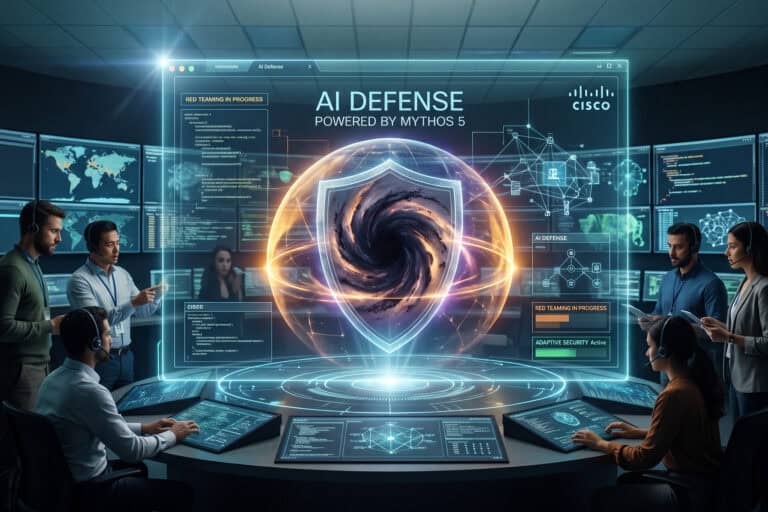
Cisco is making AI Defense much more powerful by integrating Claude Mythos 5 into it. This doesn’t mean that organizations using AI Defense now have full access to Mythos, though. Read this article to find out what it does mean.
Over the past six months, those following the AI and security markets have undoubtedly been bombarded with stories about Claude Mythos, Anthropic’s security model. It was considered so dangerous that, initially, only a select group of companies was granted access. Cisco was also part of this so-called Project Glasswing.
Whatever you may think about the hype surrounding Mythos reaching these mythical proportions, Cisco gained early access to the model and was thus able to start working with it early on. Today, the company is announcing the integration of Mythos into its own AI Defense. This integration is expected to make red teaming of the AI used by organizations much more powerful.
Rewind: what exactly is AI Defense?
Cisco announced AI Defense in January 2025. The goal of AI Defense is simple: it’s designed to enable the secure use of AI within organizations. In a nutshell, you can use AI Defense in two ways: standard and adaptive. In standard, static mode, AI Defense scans for a wide range of common vulnerabilities. For example, it finds prompt injection, jailbreaks, and exposure of sensitive data.
This standard method works well on its own against known, common vulnerabilities. However, if attackers become more sophisticated in their attempts to compromise the deployed AI, this approach to red teaming reaches its limits. That’s where the adaptive red teaming method offered by AI Defense comes into play. It’s much more tailored to an organization’s unique environment and characteristics. This allows organizations to red team their own environment in a highly targeted manner.
Adaptive red teaming gets a Mythos boost
Now that we’re in the agentic AI phase, where AI agents perform their tasks (semi-)autonomously, things haven’t gotten any easier. Especially as organizations seek to scale up their use of AI, the number of ways things can go wrong increases rapidly. In other words, you must first have your observability, security, and governance in order before you can begin scaling up. This must also happen in real time. Therefore, it requires a significant amount of intelligence and computing power.
With the addition of Mythos 5 capabilities to AI Defense’s adaptive red teaming, Cisco believes it will be possible to take the security of AI (agents) to a much higher level. Thanks to this integration, AI Defense can now generate multi-step attack paths to expose even subtle vulnerabilities. This is possible even as the infrastructure becomes more complex. Within AI Defense, every action is logged for auditing purposes.
Customers don’t actually get access to Mythos
The fact that Cisco is integrating Mythos 5 into AI Defense does not, however, mean that customers now have full access to Mythos. That would be a bit strange anyway, given all the fuss that’s been made recently about the dangers of Mythos. Moreover, it wouldn’t really work the way Cisco intends it to. Customers use the AI Defense interface, which can leverage the underlying Mythos.
We’ve been saying for many months and years now that organizations shouldn’t leave the security of LLMs up to the LLMs themselves. They really need to handle this themselves, because when it comes down to it, the models themselves are as leaky as a sieve. To be able to use them anyway, additional measures must be taken both on top of and around the models to ensure they can be deployed securely. This applies to the use of public LLMs in general. However, it certainly applies to Mythos as well. Cisco has now done just that.
Cisco tames Mythos and gives it direction
Because Cisco offers, so to speak, a tamed version of Mythos within AI Defense, Mythos now has a defined task and clear objectives set by humans. AI Defense’s red teaming engine then deploys Mythos for the task at hand.
In our view, this is a good example of how organizations should approach the use of AI in general. Not using AI is becoming less and less of an option, so it’s better to do so as safely as possible. Especially in the case of AI Defense, leveraging the power of Mythos is important. This is true because attackers also use this type of technology. The only way to respond to that is by using something that’s at least as powerful and fast.