
Fujitsu has developed a self-learning multi-AI agent technology in which multiple agents work together as a team and continuously adjust themselves based on business results, human feedback, and policy changes. The technology replaces manual adjustments by experts.
Fujitsu sees the technology as a solution to a persistent problem in business environments: regulations change, systems are updated, and work processes are constantly evolving. Yet conventional AI agents could do little with their own failures. They executed instructions but did not independently analyze why something went wrong. As a result, experts had to continuously make manual adjustments to prompts, search strategies, and evaluation criteria.
The new multi-AI agent architecture identifies the reasons behind success and failure on its own while performing tasks, extracts actionable knowledge, and adapts operational insights accordingly. Agents thus take over tasks that previously had to be continuously maintained manually by specialists. Fujitsu positions AI as the new backbone of its digital infrastructure, with internal models designed to support and accelerate all business activities.
Takane 28 points more accurate after self-optimization
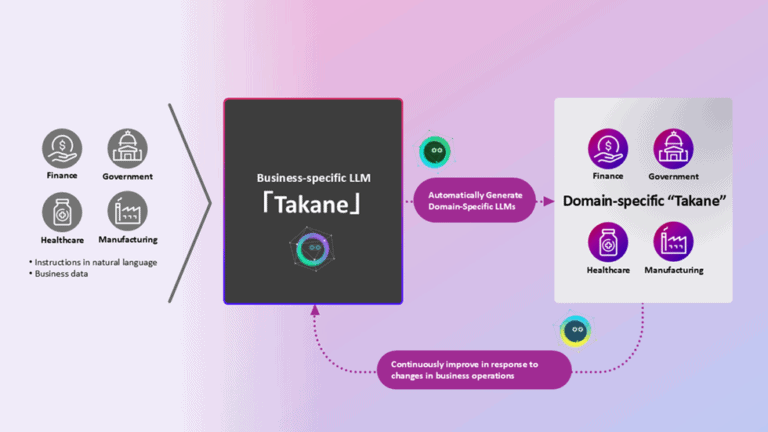
Fujitsu was the first to apply the technology to its own business-specific LLM, “Takane.” Multiple AI agents took over the entire optimization cycle: from data selection and adjustment of training parameters to evaluation and improvement. Each agent generated improvement proposals based on actual business results, but only proposals proven to be effective were implemented. The result was an average accuracy improvement of 28 points compared to the pre-specialized version. Takane was optimized for sectors such as manufacturing, healthcare, financial services, and government.
In the healthcare sector, the system now extracts structured information from unstructured medical records in a consistent format. This includes diagnoses, disease progression, and treatment policies. Techzine previously reported on how Fujitsu uses AI to address societal issues, including simulations for healthcare policy and testing cyber resilience on virtual copies of corporate networks.
From document search to autonomously improving agent
A second application involves document searches for design specifications of Fujitsu’s EHR systems for medium-sized and large hospitals and for municipal software solutions. Previously, determining the impact of legislative changes on software required experts with in-depth knowledge of regulations, business processes, and system architecture. With the new technology, AI agents learn from previous search results, failures, and human corrections. In doing so, they adopt search techniques that were previously the exclusive domain of experienced specialists, such as consulting adjacent documents or not excluding seemingly irrelevant files from the same corporate domain.
Fujitsu plans to integrate the self-learning agent technology into the Kozuchi AI platform and offer it as a core technology for enterprise-specific AI development. In collaboration with researchers at Carnegie Mellon University, the company is also working on a lighter version, intended for on-premises and edge environments with limited memory and power consumption.