
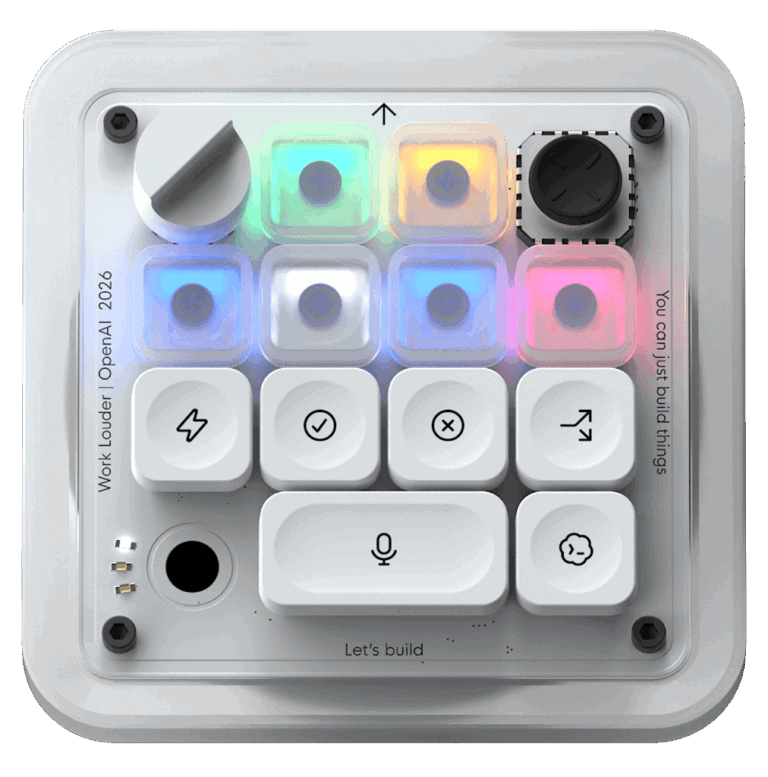
OpenAI is taking its first concrete step toward controlling AI agents not only through software but also with specialized hardware. In collaboration with keyboard manufacturer Work Louder, the company is introducing the Codex Micro, a compact control panel that allows users to physically control multiple AI agents. This shifts the focus from chat windows to a workspace where autonomous AI systems perform tasks in parallel.
The Codex Micro is not a standalone keyboard, but a programmable macro pad designed for OpenAI’s Codex environment. The device features thirteen mechanical keys, a joystick, a rotary knob, a touch-sensitive surface, and RGB lighting. Six so-called Agent Keys continuously display the status of active AI agents, allowing users to see at a glance which agent is working, waiting for input, has an error, or has completed a task.
The joystick allows users to instantly launch frequently used workflows, such as reviewing a pull request, debugging, or refactoring source code. The rotary knob lets users adjust Codex’s reasoning level during a session, while dedicated function keys make actions like accept, reject, push-to-talk, and starting a new chat instantly available. The controls can be fully customized to your preferences within the ChatGPT desktop app.
Command center for AI agents
OpenAI describes the Codex Micro as a “command center for agentic work.” Instead of managing AI agents via the desktop or mobile app, users should be able to monitor and control multiple simultaneously active agents, or even entire groups of agents working in parallel on different programming tasks, from a single physical control panel.
Although the hardware is initially aimed at software developers, its introduction primarily demonstrates how OpenAI envisions the future of AI usage. Whereas users have typically worked with a single chatbot at a time until now, Codex is increasingly focused on multiple agents that independently carry out longer tasks. The user monitors the process, makes adjustments where necessary, and approves key steps. The physical control panel is designed to make that workflow more efficient by keeping frequently used functions within easy reach.
This development aligns with the broader strategy OpenAI presented last week with ChatGPT Work. In that strategy, the company no longer positions AI exclusively as a question-and-answer assistant, but as a system capable of independently executing projects, modifying files, and working on complex tasks over extended periods of time. Codex forms the technological foundation for much of this agent functionality. More than five million people now use Codex weekly, including over a million outside the software development field.
Limited collaboration
The Codex Micro costs $230 and is available in versions with silent or clicky mechanical switches. The device supports both Bluetooth and USB-C and works on Windows and macOS. According to OpenAI, this is a limited-edition collaboration with Work Louder. The Codex Micro is therefore more of an experimental product that underscores OpenAI’s vision for agent-based workflows than a hardware product for the mass market.