
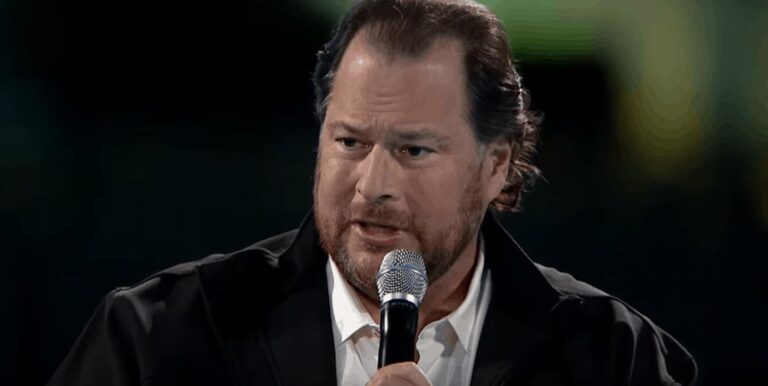
Salesforce expects to spend approximately $300 million on AI tokens from Anthropic this year. According to CEO Marc Benioff (photo), the majority of that budget will go toward AI-assisted software development. At the same time, Salesforce is working on new programming functionality within Slack.
Benioff discussed the plans on the All-In podcast. There, he stated, according to TNW, that AI coding tools now have such a significant impact on Salesforce’s development organization that software can be built faster and more cost-effectively. According to him, AI delivers benefits not only for engineering teams but also for customer service, support, and marketing.
Salesforce’s spending revolves around tokens, the processing units that large language models use. AI providers bill business customers based on that usage. An annual token bill of $300 million would immediately make Salesforce one of Anthropic’s largest customers.
According to Benioff, AI has been driving greater efficiency within Salesforce for some time. He previously noted that automation using AI agents made it possible to significantly downsize the support team. Now he sees similar effects in software development, with faster iterations and lower development costs.
Slack to Play a More Prominent AI Role
Salesforce also plans to integrate programming functionality into Slack, the collaboration platform the company acquired in 2021. Benioff hinted at new coding capabilities within Slack but provided few details.
The AI strategy for Slack was expanded earlier this year. Salesforce introduced dozens of new AI features for Slackbot, including automatic meeting summarization, task execution via external tools, and support for CRM processes. That functionality runs on Claude, Anthropic’s AI model.
AI is also growing rapidly for Salesforce financially. The company expects Slack to generate approximately $3 billion in revenue this year. Additionally, annual recurring revenue from Agentforce, Salesforce’s AI agent division, grew strongly according to recent quarterly figures.
Benioff also noted that companies need to handle AI requests more intelligently. He expects organizations to deploy an additional software layer that determines which AI model performs a task. Complex tasks would be directed to powerful models like Claude, while simpler tasks would be handled by smaller and cheaper models.
According to him, this could make a significant difference in operational costs. Large models are more expensive to use than lighter variants or open-source alternatives such as Meta’s Llama.
AI Becomes a Recurring Cost
According to market experts, Salesforce’s massive spending illustrates how AI is shifting from experimental technology to a fixed operational cost. Companies are investing heavily not only in AI models themselves but also in infrastructure and daily AI consumption.
In recent years, Salesforce has also invested hundreds of millions of dollars in Anthropic itself. As a result, the company has now built up a small stake in the fast-growing AI developer. According to Benioff, that investment was partly due to the fact that Salesforce was unable to take a position in OpenAI.