
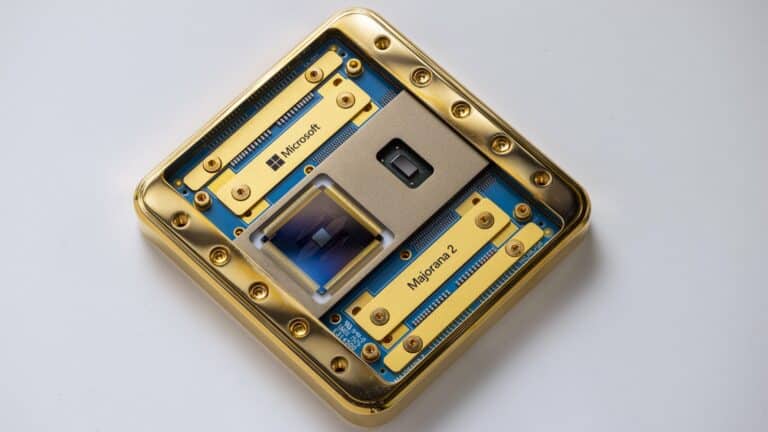
Microsoft says it has taken a major step forward in developing quantum technology. On Tuesday, the company unveiled Majorana 2, a new-generation quantum chip whose qubits, according to Microsoft, are a thousand times more reliable than those of the previous version. At the same time, the company is making its research platform, Microsoft Discovery, more widely available.
The new chip is based on topological qubits, a technology Microsoft has been focusing on for years. According to the company, the qubits in Majorana 2 can maintain their quantum state for an average of twenty seconds. That is significantly longer than with many other quantum technologies, where stability is often measured in microseconds. In some cases, the qubits even remained stable for a minute. According to Microsoft, the first generation of Majorana qubits typically lasted five to ten seconds.
Based on this progress, Microsoft expects to build a scalable quantum computer by 2029. This halves the company’s previous timeline.
A key difference from the first generation of Majorana chips lies in the materials used. Whereas Microsoft previously used aluminum as a superconductor, Majorana 2 uses lead. According to the company, this material offers better protection against disturbances that can destabilize qubits.
According to Chetan Nayak, a technical fellow at Microsoft Quantum, this change has led to a significant improvement in quality. The combination of longer qubit lifetimes, operations in the microsecond range, and small dimensions should ultimately form the basis for a practically usable quantum computer.
Topological qubits have long been considered a promising but technically challenging approach to quantum computing. Unlike many other quantum architectures, information is not stored in a single particle but distributed across multiple so-called Majorana particles. As a result, the qubits are less sensitive to local disturbances, explains SiliconANGLE. Microsoft has been investing in this technology for over a decade, while many competitors use other architectures.
AI supports development
Microsoft Discovery played an increasingly significant role in the development of Majorana 2. The platform uses AI agents for tasks including materials research, process optimization, data analysis, and the automation of measurements.
According to Zulfi Alam, who leads Microsoft’s quantum activities, AI helps identify patterns in large volumes of research data. The quantum program has now accumulated nearly two decades of data from disciplines such as physics, materials science, and manufacturing processes.
AI also played a role in fine-tuning complex qubit-based measurement processes. Experiments that previously could take weeks are now largely automated. Additionally, according to Microsoft, the systems helped optimize manufacturing processes and detect previously unnoticed production issues.
In addition to introducing Majorana 2, Microsoft announced that Discovery is now generally available to organizations. The platform combines AI agents with research and reasoning capabilities for scientific and technical applications.
In addition, a free local version is being released for individual users that works with a GitHub Copilot account.
Microsoft increasingly views AI as a tool for research and development. The insights gained from the quantum program are ultimately intended to be applicable in fields such as materials science, energy research, and the pharmaceutical industry.