
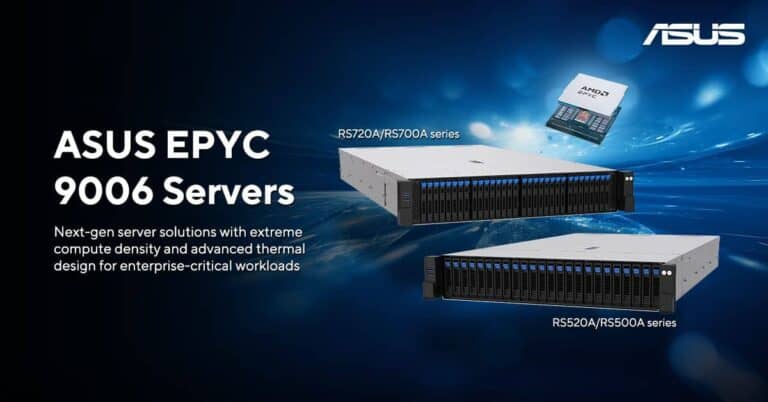
ASUS is introducing a new server line based on the 6th-generation AMD EPYC 9006 processors. Two series are designed to support enterprise workloads such as AI inference, virtualization, and cloud computing. Both are built on AMD’s efficiency-focused SP8 variant, featuring PCIe 6.0 and high-density E3.S storage.
The announcement centers on two series that ASUS is positioning for different purposes. The flagship RS700A/720A is a dual-socket system designed for maximum compute density, such as AI inference and complex simulations. A compact 2U chassis accommodates 32 DIMM slots with fast MRDIMM support and up to 32 E3.S bays.
Alongside it is the single-socket RS500A/520A. It is space-efficient, with a depth of less than 800 mm, and is designed for mainstream workloads and for racks with limited space. The series shares components with the RS700A and RS720A, enabling modular scalability.
The chips at the heart of these systems are new. AMD’s EPYC 9006 is codenamed “Venice” and is based on the Zen 6 and Zen 6c architectures. The efficiency-focused SP8 platform used by ASUS offers 8 to 128 cores, eight DDR5 channels, and 128 PCIe lanes. The top models on the SP7 platform go up to 256 cores per socket. The broader rollout of EPYC 9006 is taking place in phases.
ASUS’s customizations
ASUS is adding a series of proprietary design choices to the platform. The DC-MHS modular architecture divides I/O, HPM, fans, and storage into zones. This is intended to speed up maintenance and reduce costs. The patented DIMM.2 solution relocates M.2 storage to the cooler DIMM zone, eliminating thermal throttling without the need for additional heatsinks. Thermal Radar 3.0 with PID Control regulates the fans in real time.