
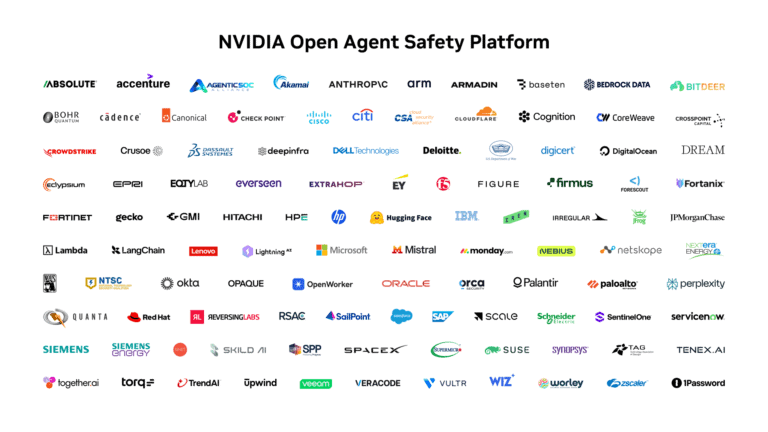
Nvidia is introducing the Open Agent Safety Platform, an open software platform and reference design to keep AI agents within defined boundaries. OpenShell monitors the runtime on Vera CPUs, while Sentry on BlueField-4 DPUs isolates anomalous behavior within milliseconds. Over a hundred organizations are participating, including Anthropic, SAP, Salesforce, and Red Hat.
The platform consists of two components. OpenShell is open-source runtime software that records what an agent does and enforces policies while it runs. The software is now widely available and works with both open and closed models. Because the code is open, OpenShell can also be extended to Arm and Intel computing platforms.
The second pillar is Sentry, an out-of-band watchdog that runs in silicon on BlueField-4 DPUs. If an agent exceeds its software boundaries, Sentry quarantines that agent within milliseconds, according to Nvidia. Sentry runs on DOCA software and verifies agent identity, telemetry, and zero-trust access rules for data, tools, and APIs.
According to Nvidia, this initiative was prompted by a series of recent security incidents in which the same pattern repeatedly emerged: the agent bypassed application-level security to complete its task. That’s why Nvidia is placing enforcement outside the model and the agent harness.
Partners and availability
Anthropic integrates Claude Managed Agents with OpenShell and BlueField. “Companies are giving AI agents more of their most important work, and they need to direct and verify what those agents do, especially in sensitive environments,” says Paul Smith, chief commercial officer at Anthropic.
Salesforce has integrated OpenShell with Slack, allowing teams to view agent activity, audit events, and approve permission requests. SAP is integrating OpenShell into the Joule Studio runtime and contributing engineering work to the project. Scale AI, SpaceXAI, Citi, JPMorgan Chase, Canonical, and SUSE are also on the list, as are robotics companies Figure, Gecko Robotics, and Skild AI.
The software is available via Nvidia’s developer page and GitHub. The platform is part of the Open Secure AI Alliance, which was founded by Nvidia in collaboration with more than 120 organizations and is governed by the Linux Foundation.