
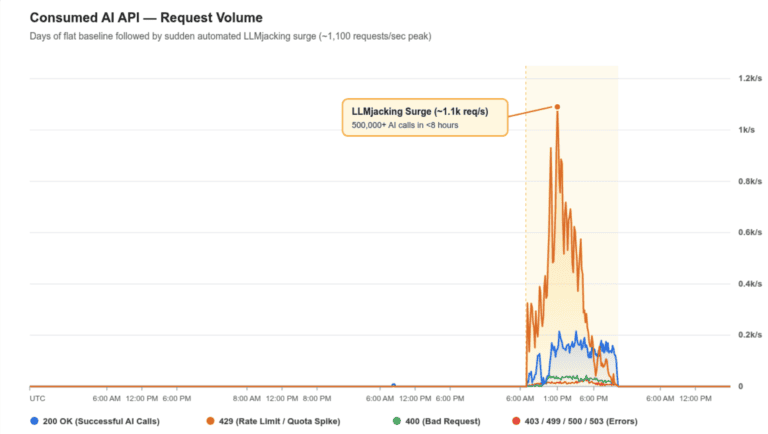
Cybercriminals are hijacking corporate access to LLMs at scale. This year, Mandiant investigated multiple LLMJacking incidents in which fraudulent cloud costs exceeded $100,000 per day. Criminals resell the stolen access via so-called LLM Mixers.
The affected organizations are located in North America, South America, and the Asia-Pacific region. They operate in the financial services, retail, technology, and transportation sectors. For some victims, the total bill reached $1 million before access was revoked.
The key difference from cryptojacking is the speed. Cryptominers slowly consume computing power, while LLMJacking causes massive spikes in API requests within hours. One attacker executed more than 500,000 LLM calls in less than eight hours.
Stolen identities as a point of entry
Unsecured endpoints, such as publicly accessible Ollama servers, represent one attack vector. However, according to Mandiant, leaked or stolen cloud identities appear to be the primary entry point: IAM credentials, Service Account keys, GitHub Personal Access Tokens, and active session tokens.
The UNC6993 group gained access in mid-2026 via a misconfigured service account key. In addition, the group hosted a fake portal that required users to paste their JSON payload along with an active access token. This allowed them to bypass password and MFA authentication. Another actor harvested API keys from public GitHub repositories and tested them with minimal requests (max_tokens=1). As a result, EDR and SIEM systems did not trigger any alerts.
Once inside, the attackers escalated their privileges. They created backdoor service accounts, disguised as billing optimization tools, and injected SSH keys into compute instances. One cluster exploited CVE-2026-40217 in the LiteLLM gateway to elevate standard Virtual Keys to PROXY_ADMIN privileges.
Resale via LLM mixers
The division of labor is striking. One group handles access, while the other profits through LLM Mixers. These are illegal gateways that bundle stolen keys and resell access. UNC6993 used open-source tools such as new-api and gcli2api for this purpose.
A striking example is Jet Night. That service passed on nearly one million dollars in token fees to a single victim. An unlimited subscription there costs about 60 dollars per month, compared to 100 to 250 dollars for a comparable legitimate consumer subscription. According to GTIG, the outages Jet Night reports on Telegram likely stem from victims revoking their keys.
Other actors went even further. They rented GPU instances in multiple regions, requested quota increases, and ran a backdoor based on the Manus agent framework.
Tip: First large-scale LLMjacking generates tens of thousands of attacks