

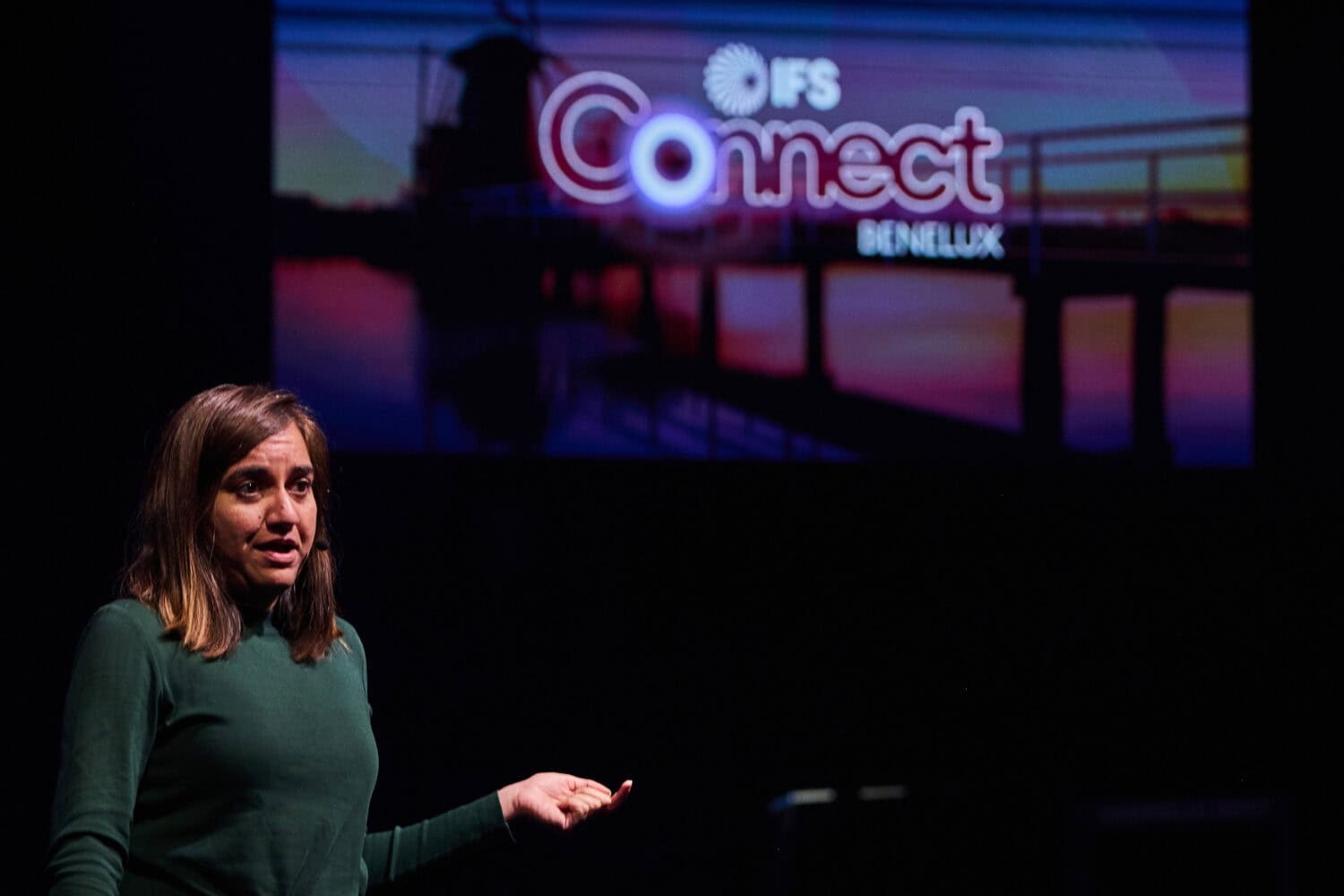
IFS Nexus Black is celebrating its first anniversary around this time. With this program, IFS aims to give the development of AI solutions within the company as much room as possible to have the greatest possible impact. That is also why it has been given its own CEO. We recently spoke with this CEO, Kriti Sharma, during IFS Connect to hear how the first year went.
IFS has always had its own perspective on AI. The company recognized early on that generative AI (which has since evolved into agentic AI) had great potential. However, it had no illusions about the role it played in its rollout. In other words, it didn’t see itself as a pioneer, but wanted to approach it pragmatically and adapt to it. We wrote an extensive article about this a few years ago.
AI takes on a greater role
Several years have passed since then, and IFS’s strategy has not changed significantly in principle. However, the company has kept up with the times and has given AI an increasingly larger role in its operations. It even held a specific IFS.ai Industrial X Unleashed event in New York last November. This is not a replacement for but rather a complement to the general IFS Unleashed event, which will take place in Orlando later this year.
This separation between the “regular” IFS and its AI division is evident not only in the events the company organizes but also internally. A year ago, IFS Nexus Black was launched. This program focuses exclusively on developing AI solutions. It is so separate from IFS as a whole that it has its own CEO, Kriti Sharma. The idea is that IFS as a whole can get started more quickly on developing AI solutions this way, because an independent unit can pivot and scale faster.
How did the first year go?
During the aforementioned event in New York, Sharma announced the availability of IFS Nexus Black’s first major achievement: Resolve. Developed in collaboration with Anthropic, this solution focuses on solving problems within Field Service Management (FSM). It was already in use at the time of the official launch, by the way. For instance, William Grant & Sons, the maker of Grant’s whisky and Hendrick’s gin, among others, announced that it expects to save 8 million pounds by using Resolve. This is because there is less downtime in the factories thanks to the use of Resolve.
Also read: IFS partners with Anthropic to accelerate AI in industrial environments
If we are to believe Sharma, William Grant & Sons is not the only success story. She speaks of “phenomenal results” in the manufacturing industry. This primarily concerns areas such as planning, servicing, and optimization. From the outside, factories may seem like environments where everything always runs the same way, but that’s not the case. Consider the example from the distillery above. In that example, the exact timing of maintenance can make a big difference in whether or not production is halted.
According to Sharma, another key driver behind the adoption of an AI solution like Resolve is compliance. With the help of AI, it’s possible to analyze highly detailed compliance guidelines and tailor policies accordingly.
No hallucinations
When we point out that we wouldn’t simply trust the output of an AI model, certainly not when it comes to keeping an airplane in the air, for example, Sharma makes a bold statement. According to her, the market for AI solutions in the IFS world is already quite mature, even when it comes to the buyers. “We no longer see any hallucinations in our field,” she adds too. That’s quite the statement.
However, there is a basis for this statement. IFS uses an internal feedback loop with clear evaluation criteria, she explains. Only when the technology does what it’s supposed to do can they actually put it into production. Furthermore, the product continues to improve the more it’s used.
IFS, and by extension the products developed by Nexus Black, also have the advantage of operating in a relatively niche market. If, for the sake of simplicity, we assume that, for example, a mechanical part of a machine can break down in only a few ways, then detecting the first signs that this is about to happen in a timely manner is, at least in theory, reasonably feasible. Of course, the models must not produce false positives or false negatives. That is precisely why the feedback loop is built in.
Pragmatic view
The fact that IFS Nexus Black did not build the Resolve solution alone, but in collaboration with Anthropic, tells us something. It indicates that Nexus Black would rather not get too involved with AI models. “We’re not chasing models, but problems [to solve, ed.],” in Sharma’s words.
This doesn’t mean that an Anthropic model is simply integrated into Resolve without question. IFS has its own models as well, as we recently heard from Chief Product Officer Christian Pedersen (see the video and interview below). Everything needs to be carefully coordinated. That’s also why Resolve was actually built collaboratively by teams from both IFS and Anthropic.
Sharma further notes that the primary benefit for organizations using AI (in this case, Resolve) does not lie in how quickly the models develop. “The biggest gains come from the scaffolding,” she explains. In other words, an AI model alone is not enough; it must be deployed correctly in the right environments. That may sound obvious, but it’s still worth mentioning again. AI models aren’t inherently very smart. They only become so when they’re deployed effectively.
Scaling up is a challenge
It’s clear that Sharma has a lot of confidence in what Nexus Black aims to achieve. “The goal is to invent solutions that solve the really hard problems in the industrial sector,” she says. According to her, they have already demonstrated that they can do this. The results from Resolve show that things aren’t just incrementally better, but significantly better. That’s quite a bold statement based on the (initial) results of a single solution. We would wait a little longer before making claims like this, even though we certainly understand the optimism.
Sharma actually sees no technological limitations when it comes to AI adoption. The main challenge will be scaling up the use of AI, initially in the areas of FSM and the manufacturing industry. However, it will subsequently also be important in the other verticals that IFS targets. This means that organizations will need to redesign processes, deploy people differently, and have them work differently. That is a much greater challenge than developing the right technology. The early adopters are willing and able to do this; the question is how long it will take for other organizations to follow suit.
“The Industrial AI moment is coming soon”
Despite the challenges surrounding scaling the use of AI in industrial environments, Sharma seems to have no doubts. “The Industrial AI moment is coming soon,” she asserts. Until now, it has mainly been knowledge work that has benefited from AI, but the industrial world will quickly follow if it’s up to her. “There’s no reason not to get started with it,” she says.
The statements above are to be expected from someone responsible for rolling out AI in industrial environments. However, the initial feedback and results we’ve seen and heard are indeed very positive, so these statements are certainly not unfounded. That said, we’d still like to see a few more solutions emerge from IFS Nexus Black before we fully commit to the narrative. The first year, however, can certainly be called a success. In the coming years, we’ll see what else IFS Nexus Black has in store.