
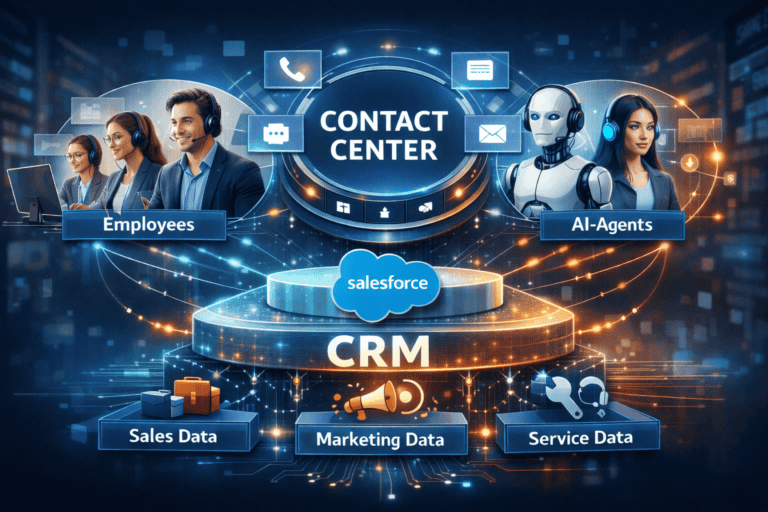
Salesforce has significantly improved its Contact Center solution, Agentforce Contact Center. Agentforce Contact Center combines voice (telephony), digital channels, CRM data, and AI agents in a single platform. The goal is to serve customers much more effectively, regardless of how they contact you. Salesforce promises less repetition for customers, less manual work for employees, and supervisors who can see the full picture.
Many large contact centers have been working for years to solve the same problem: customer data is stored in the CRM, calls are handled through a separate telephony system, another system handles digital channels, and on top of that, AI tools and integrations have been built over the past year. The result is that employees switch between various systems to help customers. Meanwhile, those customers have to repeat themselves every time they are handed over, and supervisors find themselves struggling to really get a grip on what is happening. Salesforce now wants to break through this by bringing everything together on one platform and letting AI connect everything, with good transfer.
Read also: Salesforce research: poor data quality hinders AI potential for three-quarters of marketers
AI ensures a smooth handover
What Salesforce has done with this new version of Contact Center is to add AI to the core of the application. This allows AI to assist at every step, better serving the customer. In addition, it has aligned a number of workflows so that customers have a consistent experience across phone, chat, and other digital channels.
One of the most annoying moments as a customer when you contact a contact center is being transferred to a colleague and then having to repeat your entire story. For many people, contacting an organization’s customer service has therefore become a hurdle.
AI agent as point of contact
Salesforce is now introducing a best practice in which an AI agent is the first point of contact in almost all cases, whether via chat or phone. Today, it is possible to have a conversation with an AI agent that responds fairly quickly. Ultimately, as an organization, you decide which tasks an AI agent can perform autonomously. For example, an AI agent can probably initiate a return procedure if someone has received a broken product, but it probably cannot offer a discount in the event of problems or emergencies. In that case, the customer must be transferred to a human agent to assess and handle the situation.
This transfer from an AI agent to a human employee is extremely important. This escalation should not be a new starting point; it should continue the conversation. This means that an employee receives the conversation history in text, whether it was a voice or chat conversation, but also a short summary of what is going on. This means that the human agent does not have to read everything and can immediately verify the situation based on the summary: “You want to return a defective product and receive a discount on the new product?” To which the customer can simply answer ‘yes’ or ‘no’.
CRM plays an important role
Salesforce also links the entire CRM to the Contact Center, making not only this case visible, but also the entire customer profile. This includes all previous purchases, marketing campaigns, and service history. Based on this information, an AI can also make recommendations, for example: “This is a loyal customer who places large orders every year, never complains, and is now disappointed. An appropriate discount is in line with company policy.”
An AI can analyze this in a fraction of a second based on all customer data and advise a human agent. Without the agent having to read all orders and service requests.
AI takes conversation notes
Something similar applies to processing conversations after they have taken place. Employees must summarize the conversation. It must be recorded in the system so that colleagues also know what was discussed and, above all, what was agreed. Depending on the type of organization, this used to take 5 to 30 minutes, depending on the amount of information. Now it can be done in a few minutes, because AI can automatically transcribe and summarize everything. The human agent only needs to check that it is correct. This can result in enormous time savings.
Compass Working Capital is a good example
At Compass Working Capital, an American non-profit, coaches used to spend up to 30 minutes per appointment manually entering structured meeting notes into Salesforce. Now, an AI agent takes over that task immediately after the meeting: it recognizes which information is relevant, checks it against existing field validations, and suggests to the coach what needs to be entered. This is expected to save the organization 6,000 working hours per year, hours that coaches can now spend on complex or long-term customer relationships.
Voice as a data source
One of the more interesting shifts is what happens to voice data now. Previously, phone calls largely disappeared into thin air after they ended: there might have been a recording, but it was separate from the CRM and was rarely used systematically.
In Agentforce Contact Center, voice is processed natively within the Salesforce platform. Calls are transcribed in real time, linked to the customer record, and used to continuously improve AI agents. This also gives supervisors insight into customer sentiment across all calls, not just through random samples, but based on complete data.
Supervisors manage everything from a single dashboard for AI agents and employees
What we saw as a major advantage during the pre-briefing with Salesforce is that everything comes together in a single dashboard and a single workflow. Some organizations, for example, assign important customers to a different department or specific account managers. These managers can or are allowed to be a little more flexible or give bigger discounts. If you configure this in Contact Center, you do so directly for voice and all digital channels, but also for both AI agents and employees. This means you can also assign important customers to a different AI agent who autonomously has slightly more options than the standard agent.
These routing rules can be configured by any supervisor without technical knowledge.
Salesforce customers benefit most
Agentforce Contact Center is now available as an add-on for existing Agentforce Service customers in the United States and Canada. It will undoubtedly become available in more countries later this year. However, it is clear that the added value is greatest for organizations that make extensive use of the Salesforce platform. In that respect, the best-of-suite strategy that many vendors embarked on a year or two ago is still very much relevant.
Basically, much of the technology that Salesforce is presenting today is not new. What is new is that it brings everything together in one place. In our opinion, the biggest challenge is not in the software, but in the organizations that want to use it. It requires a fairly innovative mindset, and many existing processes will have to be overhauled. An AI agent that is allowed to help customers autonomously requires trust, clear policies, guardrails, and management that dares to let go. Those who don’t have that in place, or don’t dare to do so, will end up with an expensive contact center with a dash of AI. Those who dare and get their organization on board can quickly make great strides.