
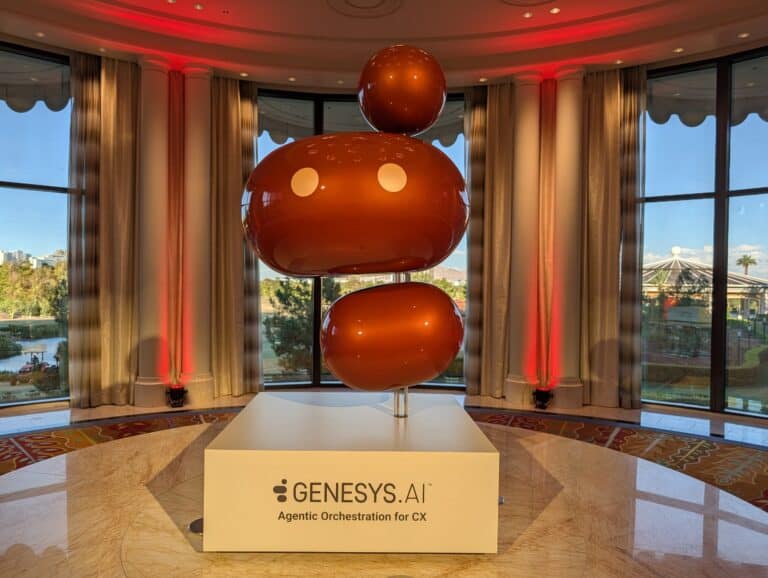
In the coming years, companies will need to rethink their operating models, not just add AI to their processes. That is the key message Genesys is conveying at its Xperience 2026 conference in Las Vegas. The foundation for this is an “agentic orchestration layer” tailored for customer experience (CX). What’s next for the platform?
In a press briefing ahead of the keynote, CEO Tony Bates outlined how AI is rightly changing expectations in CX. In particular, the personal use of AI in people’s daily lives is shaping customers’ expectations of companies. As a result, the bar is rising.
Whereas AI assistants initially focused mainly on answering questions, they now possess contextual intelligence about the user. Bates used himself as an example. His AI assistant knows his health status, fitness routine, restaurant preferences, and calendar. According to him, that experience directly translates into expectations for companies. Consumers wonder why their bank or insurance provider can’t do the same.
The irony is that companies actually do have that context. They know which products you’ve purchased, which cases are open, which campaigns you’ve clicked on, and with what intent you previously reached out. However, all that data is scattered across systems that don’t communicate well with one another. That is precisely the problem Genesys aims to address with the agentic orchestration layer, or, as the company further specifies, the Agentic Operations Platform for CX.
Five shifts in the operating model
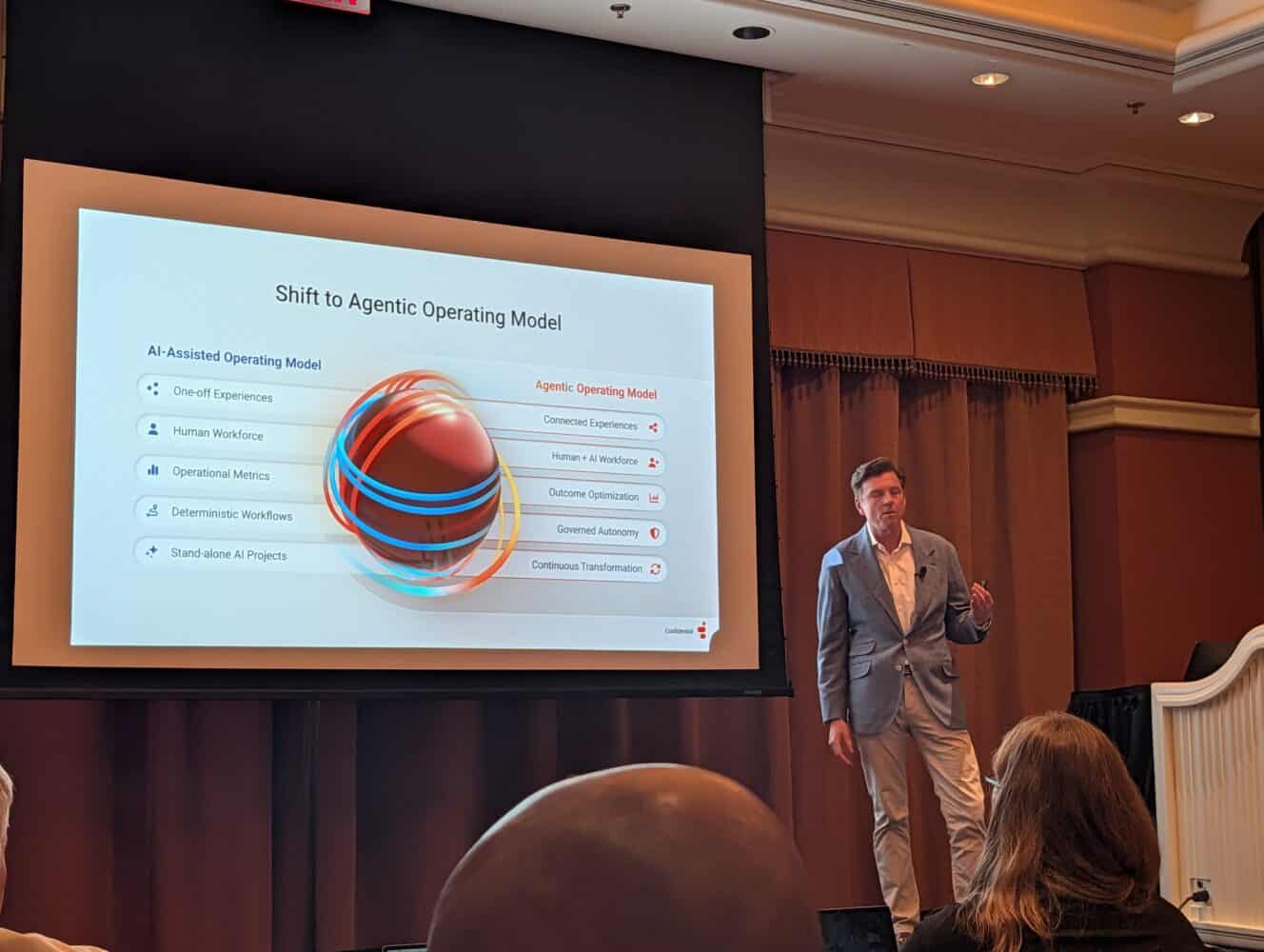
Bates identifies five areas where he believes organizations need to start thinking differently. The first concerns isolated interactions versus connected experiences. Most CX strategies still revolve around handling a single touchpoint, such as a password reset. That’s no longer enough.
The second point concerns workforce composition. Genesys refers to a hybrid workforce in which humans and AI agents work together. This goes beyond simply automating tasks, according to Bates. It touches on performance management, talent development, and even onboarding: how do you train an AI agent the same way you train a new employee?
The third shift lies in the metrics. Bates referred to traditional contact center KPIs such as Average Handle Time and first-contact resolution as nothing more than proxies. Genesys prefers to focus on outcomes that are continuously optimized.
Bates: “CEOs ask: How do you save me money while simultaneously generating revenue?”
Governance as a prerequisite, not a hindrance
Point four revolves around autonomy. Genesys believes that AI should indeed be allowed to act independently, but only within strict parameters. According to Bates, guardrails, traceability, and audit capabilities are built into the architecture. With more than 7,500 customers, including large international organizations, this is no minor matter. Customer data remains the customer’s property. In this view, governance is not a barrier but an enabler. It determines when AI can take action on its own and when a handoff to a human is necessary.
The final point concerns the nature of transformation. Large IT projects traditionally had a beginning and an end, think of an ERP migration or the switch to CCaaS. According to Bates, that logic no longer holds. Innovation is happening too quickly, and companies want to do too much at once. Continuous transformation thus becomes part of the operating model itself.
Maturity model and level 4
Two years ago, Genesys introduced the Levels of Experience Orchestration, a maturity model for CX automation. Many companies are still in the early stages: predefined, human-driven processes. The classic CX menu (press 1 for sales, 2 for service) is the best-known example of this.
Genesys now positions itself at Level 4, where AI agents can actually be orchestrated. This is a realistic achievement when we look back at what the company announced last year at Xperience 2025. At that time, the theme was that AI agents would take the reins of the customer experience, with capabilities such as Work Automation, Genesys Cloud Associate, Copilots, and Virtual Agents.
The orchestration ambition extends beyond its own platform. Genesys also aims to integrate with ERP, CRM, and industry-specific software. To that end, the company is working on integrations with other vendors, with Salesforce and ServiceNow as key partners.
Breaking through the AI paradox in customer interaction
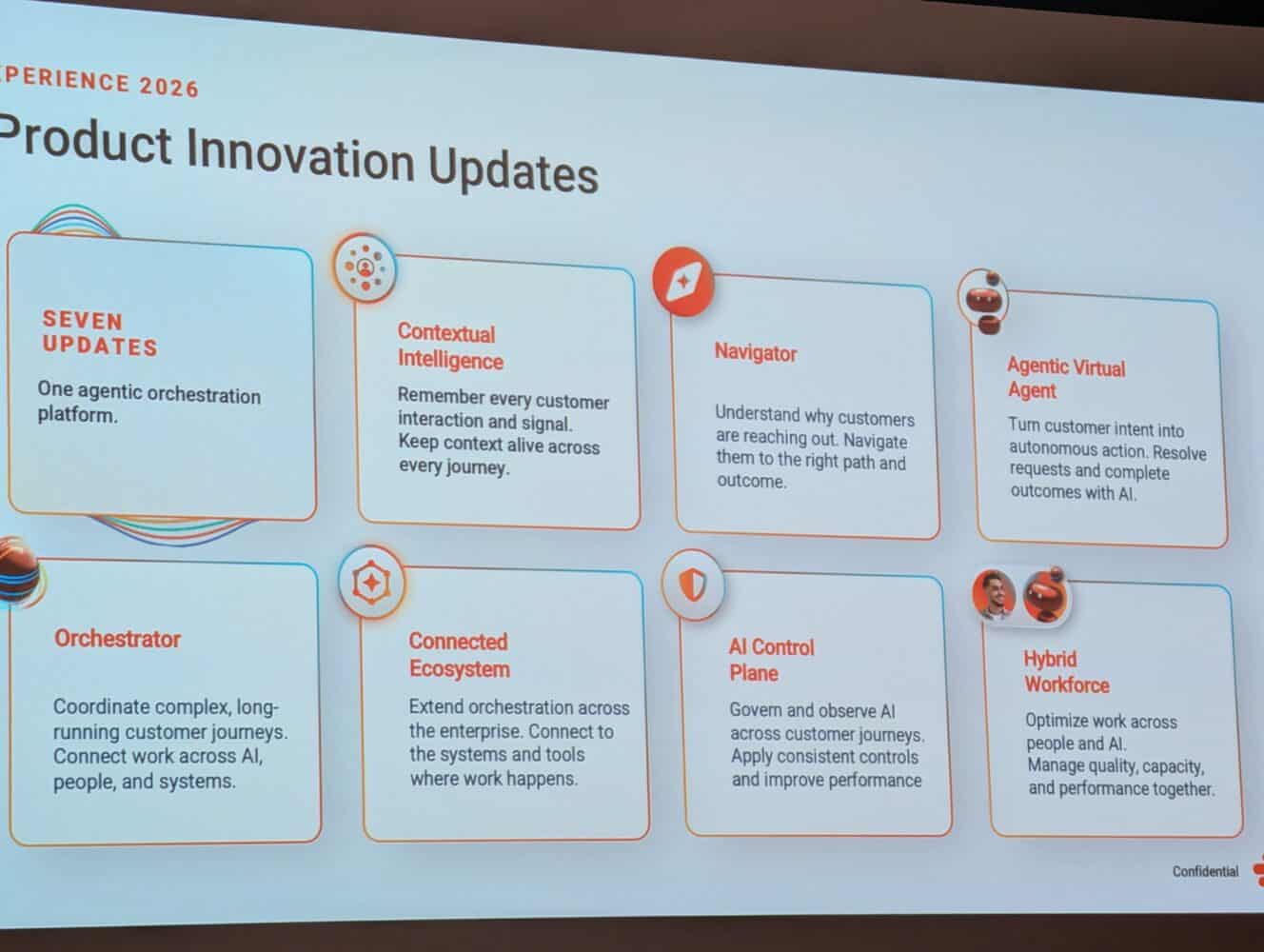
If we extend that line of thinking to the announcements at Xperience 2026, we see seven product innovations stealing the show. What they have in common is exactly what we started this article with: not simply adding AI to processes indiscriminately. General Manager, SVP, and Head of Product Mike Szilagyi calls this the AI paradox: more AI agents actually lead to a fragmented customer experience.
Over the past twelve months, Genesys has observed a clear shift among its customers. Whereas last year companies were still selecting an AI vendor or hyperscaler to build a single use case, those same organizations are now on their second or third application. And that’s where the problems begin. Scaling up, it turns out, is a very different challenge from getting started.
Szilagyi: “Adding more AI, you wouldn’t expect that to be the paradox, does indeed create challenges and leads to customer fragmentation.”
Each standalone AI initiative works, but to the customer, the sum of these initiatives feels like a series of disjointed conversations. According to Szilagyi, the new operating model requires a layer that ties together intent, business goals, and execution. This is achieved through the agentic orchestration layer, which in this case is fully dedicated to CX.
Contextual intelligence as a foundation
The first of the seven announcements centers on contextual intelligence. Traditionally, companies make an API call to the CRM to find out what’s going on with a customer. Genesys wants to go further and make the history of intents, journeys, and behavior on websites, mobile apps, and e-commerce platforms permanently available to AI.
Szilagyi admits that journey management was primarily an analytical tool. Now, third-party events can also be ingested in real time. “It’s not about the data being stored somewhere and just hoping you’ll see it,” says Szilagyi.
Navigator replaces the IVR
The second announcement is Navigator, an LLM-based front door for the organization. For decades, Interactive Voice Response (IVR) filled that role, with all its well-known frustrations. Some companies simply put a single AI agent at the front door, but according to Genesys, that approach fails for multinationals with dozens of divisions and thousands of possible intents. Navigator, however, is designed to handle that conversation.
In addition, the Agentic Virtual Agent (AVA), launched earlier this year, is getting an upgrade focused on the voice experience. The idea is that latency, glitches, and a robotic voice cause customers to lose trust in a bot.
Building with Claude and Cursor
Noteworthy is the development environment Genesys is building around its virtual agents. Customers can use their own AI tools for prompt-based design, upload business documents, and convert them into a working agent via a spec-driven development interface. This is followed by a testing framework that runs thousands of simulations before the agent goes live, plus metrics to monitor its ongoing performance. Options include Claude Code, OpenAI Codex, and Cursor.
This aligns with the path Genesys previously took with AI Studio, the development and governance layer within Genesys Cloud. Its first capability, AI Guides, allowed users to create virtual agents without code, based on natural language or existing documentation, with safeguards against hallucinations. The platform is designed to be model-agnostic.
Orchestrator plans, actors execute
The biggest architectural step is Orchestrator. Genesys, of course, already performs orchestration, but did so in a highly “directed” manner: fixed routes through a flow. Orchestrator adds agentic AI to this using the same approach as with the virtual agents. You provide the system with policies, goals, guardrails, and the tools available within the organization.
Orchestrator then devises the ideal plan itself and delegates it to what Genesys calls the “actors’ plan.” These can be proprietary AI agents or agents from a third-party ecosystem. The system listens for signals and adjusts the plan during execution. After all, customer journeys rarely follow the “happy path,” which is precisely the industry’s biggest frustration, according to Szilagyi.
The connection to the rest of the enterprise is provided by Pinkfish, which Genesys acquired on June 30. Pinkfish brings more than 500 integrations and support for 25,000 MCP tools across CRM, ERP, IT, HR, billing, and order management. Genesys expects to have these capabilities available in AppFoundry by the end of July and natively embedded in the platform by the end of January 2027.
The difference from a traditional integration lies in the approach. Instead of an API call with a rigid contract, it uses AI that exchanges context with another AI agent and works together to reach a solution.
Tip: Genesys and ServiceNow are strengthening ties for collaborative AI agents
Announcement six is about governance. Genesys refers to an “AI control plane,” a term that, according to Szilagyi, the industry is beginning to converge on. It is a set of capabilities that determines who gets access to which AI tools, what they’re allowed to do with them, how to discover available tools, what decisions agents make, and how to disable them if necessary. This functionality is already included in Genesys Cloud and will be further expanded.
Hybrid workforce
The latest announcement concerns the workforce management suite. AI agents are now working alongside human agents, transforming the entire WEM stack. Genesys is now also applying its quality management programs to AI agents: recordings are reviewed and scored for both groups. For AI agents, a short feedback loop feeds back to the development platform for optimization.
Forecasting and scheduling may be affected even more significantly. AI is changing not only the volume of work assigned to humans but also the type of work. Genesys expects employees to take on more complex tasks, work that requires empathy. The platform must be able to identify, predict, and blend both AI-driven and human-driven work.
Finally, speech and text analytics are shifting from retrospective analysis to real time. This information is sent to agent copilots, so that employees can correct themselves during the call, and to supervisors who can intervene immediately.
This makes Genesys’s course for the foreseeable future clear. A new operational model for businesses can be achieved by getting the orchestration layer in order, something Genesys is perfectly positioned to deliver.