
During Scale Computing’s own Platform//2026 Summit, one overarching theme is abundantly clear. Scale is making the hardware requirements for systems running the company’s software increasingly less stringent. This is partly a response to the current state of the IT industry and partly a clear signal of growth. Within the AIP (Authorized Imaging Partner) program, Scale, its partners, and end customers alike can achieve more on an ever-wider range of hardware platforms.
Scale has always sought to ensure that its own edge platform, HyperCore, runs on more than just its own appliances. For some time now, two versions of the software have been available for MSPs to deploy at customer sites, according to Ian Smith, VP International at Scale Computing: a certified version and a validated version. If you purchase appliances directly from Scale via MSPs, they will have the certified version. If the customer and/or MSP prefer to choose the hardware they want to use themselves, they install the validated version of the software on it.
The ability to choose your own hardware is part of the AIP program. AIP stands for Authorized Imaging Partner. Partners under this program can still opt for their own hardware within certain parameters. This might be because they currently have equipment that’s suitable for running Scale. Or they might be able to purchase something elsewhere at a good price.
Adapting to current conditions
With the supply chain issues surrounding RAM and NAND flash, everyone has to get a bit more creative anyway. Scale has recognized this and recently relaxed its hardware requirements even further. In fact, it recently launched a campaign to specifically equip Dell VxRail hardware with Scale software, announcing that it is adding 14th, 15th, and 16th generation VxRail devices to the list of supported hardware. That hardware undoubtedly runs primarily on VMware. Scale aims to replace that with its own solution.
When we ask Smith what the current system requirements are for installing Scale’s software on other hardware within the AIP program, it turns out to mainly concern the disk controller (if present) and the NIC (network interface card). This is actually a bit more specific than it might seem at first glance. There are often quite a few variants of a NIC. Scale’s requirements can be quite specific. So, for now, it’s not the case that all NICs from a specific product line—say, A10—are automatically compatible just because one is.
Relaxation is a step-by-step process
There is, incidentally, a good reason not to relax the system requirements too quickly, Smith continues. “We always want consistency in performance and experience; that has always been one of the most important aspects of Scale,” he explains. In other words, by loosening the reins too quickly, Scale runs the risk of customers having a subpar experience. And then Scale would be indirectly held accountable. Smith is well-positioned to make statements such as this, having been at the company since 2012.
In any case, the initial results of giving MSPs and customers more freedom in their hardware choices are undoubtedly positive. In the first quarter of this year, more than seventy percent of Scale’s business was software. That represents strong growth, according to Scale’s spokespeople, though it’s not entirely clear how significant that growth is compared to a year ago. Since the acquisition last year, little has been disclosed about the financial results anyway.
Read also: Acumera becomes Scale Computing through acquisition
No longer a significant difference between certified and validated
If we read between the lines of what Smith says, as well as partner Michael Ross of New Zealand-based Holistec Systems, it does seem, however, that it won’t be long before the choice of hardware is virtually fully open. The software probably supports more hardware than Scale officially supports already. An example Smith cites is that while a HyperCore cluster can formally have a maximum of 8 nodes, this does not mean that more nodes cannot be added. Something similar might already be true for the underlying hardware requirements.
From Scale’s perspective, the few limitations that existed in the validated variant compared to the certified version in terms of functionality have, in any case, been removed. There was another difference where the certified variant offered more network capabilities than the validated version, but that is no longer the case. This prompted Ross to ask out loud during our conversation why anyone would still opt for the certified variant. Now that there appears to be no difference in software and more and more hardware capabilities are emerging, this is becoming apparent.
“White label” as an extra option
Running Scale software on self-selected hardware gives MSPs and customers more freedom to do business. However, it is also becoming increasingly feasible to deploy Scale’s software with a white-label approach. This means that MSPs can get started with Scale’s stack—whether or not on officially certified hardware—and build their own layer on top of it.
Jannik Uffmann of the German MSP DTS Systeme (which uses SC//HyperCore in its own data centers but also offers it to customers as an MSP) indicated in a conversation with us that he plans to do something similar. They are currently still using the SC//Fleet Manager software for orchestrating SC//HyperCore, but plan to build their own tool for fleet management on top of it. That will then be the interface customers see. Smith also provides several examples from the UK and France, among other places, where MSPs are successfully doing this.
Toward a Unified Edge Platform (HyperCore and Reliant)
There will undoubtedly still be customers that opt for that variant due to auditing reasons or the belief that a certified version of the hardware chosen by Scale offers better after-sales service and support. However, there is increasingly less reason to do so.
Add to that the fact that the edge platform, the Reliant platform, which entered Scale Computing’s portfolio through the acquisition of Acumera, has historically claimed to be fully hardware-agnostic, and sticking to hardware restrictions for HyperCore becomes even more difficult. In a keynote during Platform//2026, Scott Loughmiller, Scale’s Chief Product Officer, makes it very clear that the company wants to move toward a Unified Edge offering. That means Reliant and HyperCore will be combined into a single edge offering. That’s perfectly fine in itself, because there is relatively little overlap between the two platforms. In terms of underlying hardware, it’s undoubtedly also convenient to standardize it.
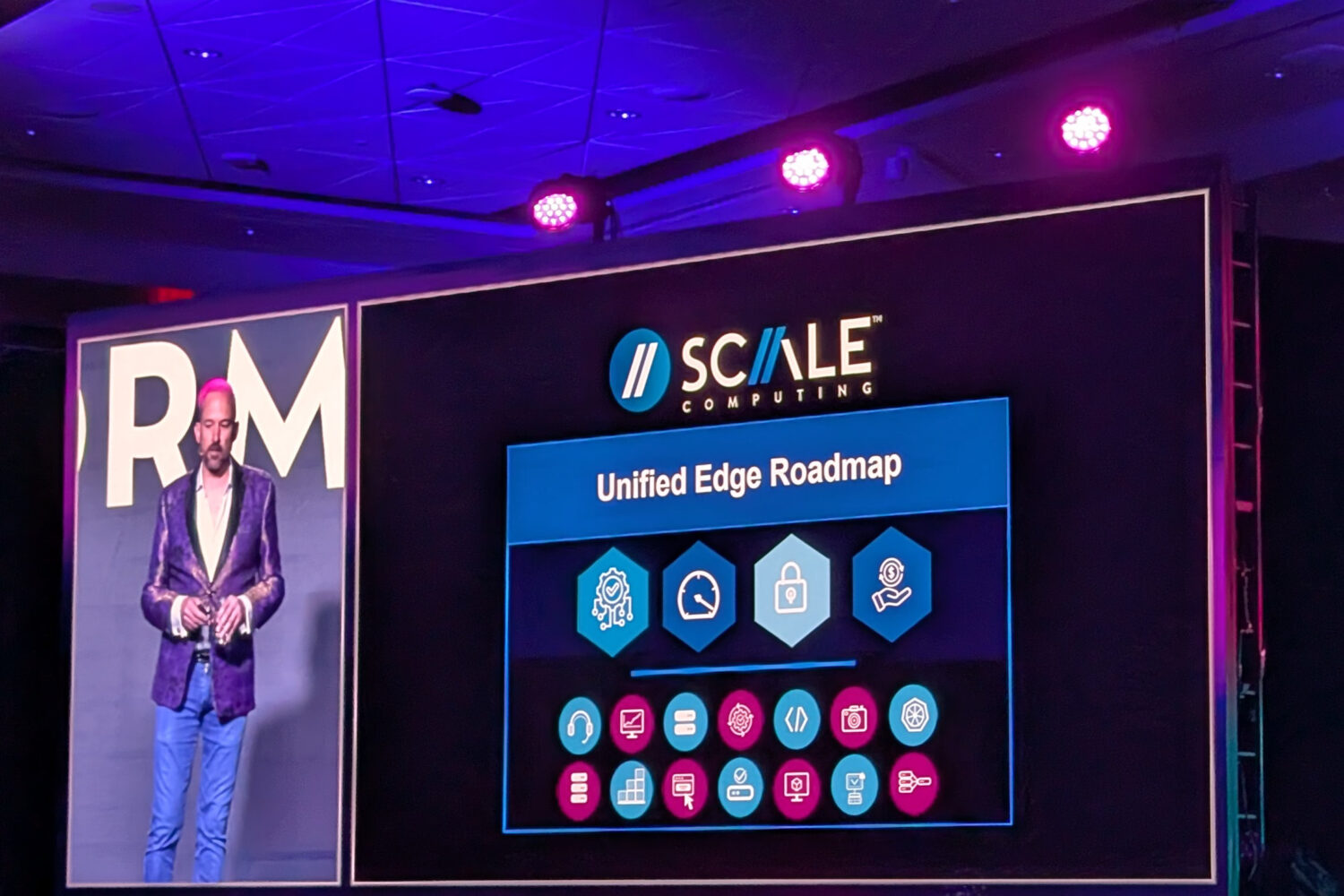
Loughmiller is therefore quite clear during his keynote about AIP and freedom in hardware choice: “We’re going to blow off the doors [of the hardware limitations, ed.].” So it won’t be long before virtually all restrictions are lifted, we dare to conclude. In itself, this development also makes sense. A focus on software is generally a better growth strategy than a focus on hardware.
Full support for validated version
The fact that software like Scale Computing’s can and is allowed to run on other hardware is an important step. Even more important for MSPs and end customers, however, is that the validated version of Scale’s software receives full support. It gets the same support as the version officially certified by Scale, we hear from Smith. That’s yet another reason to take a broader look at how organizations can deploy Scale.
All in all, Scale Computing is increasingly paving the way to bring the company’s edge platform into more and more organizations. This is a logical development in itself, as the company has always identified itself as a software company. In that case, you can’t have too many restrictions on the underlying hardware. There will undoubtedly still be customers for a long time who prefer to purchase everything fully certified by Scale. However, their numbers will undoubtedly decline.
It is now up to Scale to ensure that all of this happens in a way that aligns with the company that has made simplicity and consistency two of its core goals. It is clear not only that the software is being further decoupled from the hardware, but also that the integrated platform Scale Computing now intends to bring to market is inherently more complex than what the company offered prior to the acquisitions. That will also be an interesting journey to follow. We’ll discuss this in a future article. We’ve also spoken with Scale Computing’s Chief Operating Officer, Mark Cree, about this and other topics.
Read also: New Scale Computing launches new Velocity partner program