
Dell Technologies World 2026 showcases a company that has stripped its strategy down to the essentials. Dell built an open infrastructure stage; it’s up to partners and the market to shine on that stage. That’s not a weakness, but a deliberate choice. It does raise the question, however, of whether Dell Technologies is selling itself short by doing so.
We asked Sam Burd, Chief Strategy Officer at Dell Technologies, whether the company is consciously choosing to provide the infrastructure stage on which others can perform, without the company attempting to do so itself. He confirmed this in a conversation with Techzine: “I think I agree with how you characterize that.” We also asked him whether it isn’t tempting in these times of AI to build more solutions of its own that can operate on that platform, but he more or less indicated that it’s best to focus on the things you’re good at. “We’re a lot better at the things related to our platform. We bring in other parties to use the platform,” by which he was referring to all the partners Dell Technologies is currently collaborating with.
Read also: Dell announces AI Factory expansions at Dell Technologies World
The infrastructure platform is not a feature
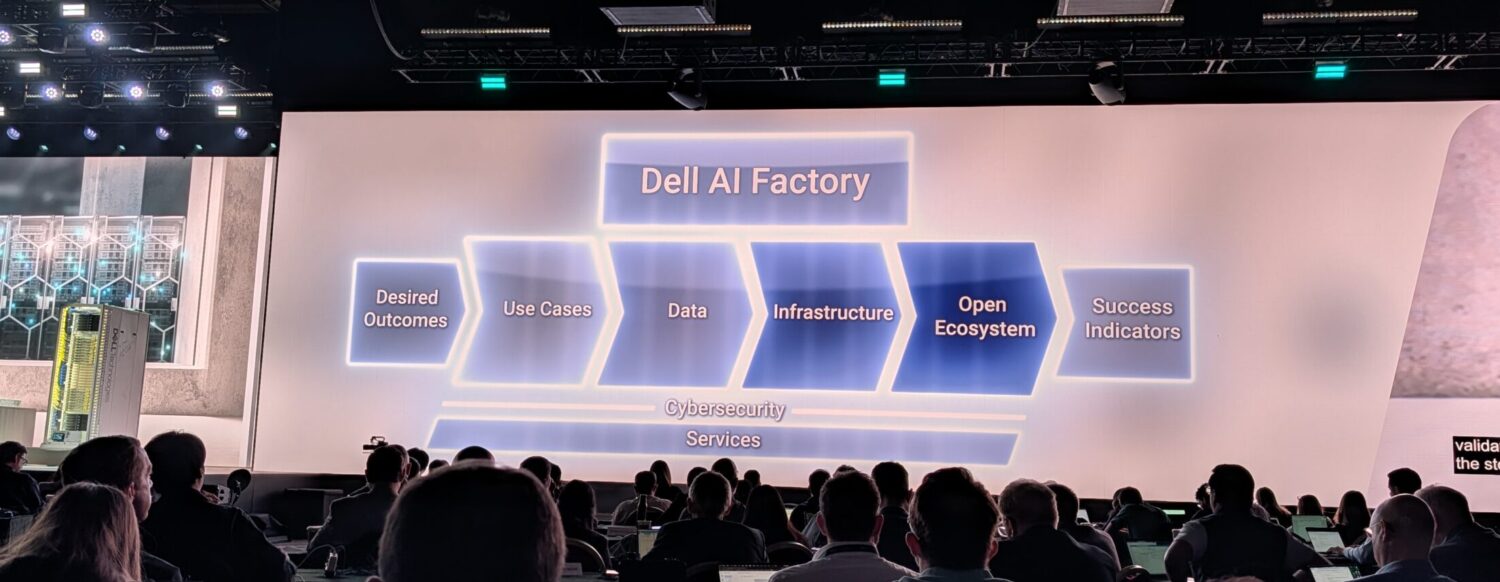
Let there be no misunderstanding: Dell has built something substantial. The Dell AI Factory offering and the combination of PowerStore, PowerScale, ObjectScale, PowerFlex, and Lightning File System (five different storage solutions) available on a single hardware platform is also innovation. It represents years of development and in-house engineering by Dell Technologies. The PowerRack architecture, the validated deployment blueprints, the orchestration and management layers, the Automation Platform, and lifecycle management didn’t just appear out of thin air either. According to IDC, Dell is the market leader in rack shipments, with more than 2.2 times as many racks as its nearest competitor.
The number of partners working with Dell’s AI Factory is also growing steadily; Google, OpenAI, Palantir, SpaceXAI, Hugging Face, ServiceNow, Mistral. They’re all operating on the Dell platform. Dell has deliberately invested in validated blueprints and deployment automation to make that platform as attractive as possible to partners. That has resulted in 5,000 AI Factory customers in a single year, and that is a significant number.
The intelligence and AI come from others
Dell does not build AI models, AI solutions, or AI software. While it is trying to position itself in the market as an AI player, that is not really what it is. Dell provides the hardware, a portfolio of workstations and servers that are highly suitable for AI workloads, but that is where it stops. In virtually all cases, the GPU acceleration and AI computing power come from Nvidia. The orchestration software is open-source, and the analytics layer in the AI Data Platform runs on Starburst and Nvidia RAPIDS. Cyber Detect is technology from Index Engines. NemoClaw is, again, an open-source tool.
Burd also implicitly acknowledged this when we asked him about Dell’s own software. At Dell Technologies, the focus is almost entirely on orchestration and management software. So, just managing the hardware that Dell Technologies supplies. That is precisely the focus we described earlier: Dell manages the infrastructure stage; the lights, the sound, the curtains, but the act belongs to others.
That is a deliberate choice with a strong focus. The bottom line is that Dell is active in storage, compute, networking, orchestration, and platform management, but not in AI intelligence.
Dell is, however, heavily dependent on Nvidia
Dell AI Factory with Nvidia, the product name says it all. Burd was candid: “Most of the volume that we’re doing is with NVIDIA.” While Dell does sell servers with AMD, we didn’t hear a word about that during Dell Technologies World. Dell’s AI story is almost entirely built on Nvidia’s hardware, Nvidia’s software stack, and Nvidia’s roadmap. Without Nvidia, there is no AI factory.
Broadcom has given Dell a gift
The arrival of Dell Private Cloud as an alternative to Dell VxRail is a direct result of Broadcom’s acquisition of VMware. Caitlin Gordon, VP of Product Management for Private Cloud, was open about it: “Without that acquisition, I don’t think anyone would be rethinking their entire data center the way they are now.”
That’s remarkably honest. Dell is reaping enormous commercial benefits from a disruption it helped cause. Dell Technologies sold VMware to Broadcom. The customers now switching to Dell Private Cloud are partly paying the price for that deal, while Dell is now selling the solution.
Gordon also acknowledged the awkwardness of that conversation: “Customers come to us because they ultimately trust us, even if they’re also a bit frustrated with the whole situation.” That frustration is understandable. But the pragmatic conclusion is that Dell benefits commercially from it, and that the 65% cost savings compared to HCI is a real advantage that helps customers get past that frustration.
Cheaper than HCI
That 65% cost savings compared to HCI isn’t just a marketing figure; it has substance. Gordon clearly explained the mechanism: by disaggregating compute and storage, you no longer need to put expensive memory and drives into compute nodes. Separate scaling means you no longer pay for overcapacity on one side. Fewer cores in the environment mean lower hypervisor licensing costs, a direct blow to Broadcom’s business model.
The comparison holds true for customers switching from a traditional HCI configuration to Dell Private Cloud with a bring-your-own-license approach. For customers who purchase VxRail licenses through Dell and compare that to Dell Private Cloud, the picture is slightly less clear-cut.
The proprietary hypervisor is small but significant
Dell has, in fact, developed its own hypervisor. Dell Distributed Private Cloud, formerly Dell NativeEdge, runs on its own KVM variant. This was never explicitly communicated, but Gordon confirmed it: “That has always been our own KVM hypervisor.”
The scope of the hypervisor is limited, however: 2 to 4 nodes, focused on edge and distributed environments. Gordon was clear about why it isn’t being expanded further: “Enterprise-scale hypervisors require years of investment and development. That might not be what a Dell customer needs.” Competitor HPE, on the other hand, has chosen to go down that path and, since acquiring VMware, has developed its own enterprise-grade hypervisor; it has also made acquisitions to accelerate that process.
In that regard, Gordon’s statement says it all. Dell is looking at the enterprise hypervisor market, knows what it takes to compete seriously there, and is consciously choosing not to do so. Providing the platform is and remains the strategy. Taking the stage with its own enterprise-grade hypervisor is not.
For AI, the token economy is the selling point
Dell’s latest selling point is the token economy. A developer working with 10 agents can burn through thousands of dollars in cloud token costs each day. Running on-premises means fixed infrastructure costs instead of variable API costs.
Although the argument is valid, it is an infrastructure argument, not an AI argument. Dell isn’t selling better AI. It’s selling a way to run AI more cheaply. Burd confirmed this as well: “We would say be smart on where you’re routing the tokens.” Organizations would be wise to develop a strategy for deciding which token traffic goes on-premises and which goes to the cloud. That routing is completely open: customers can work with any cloud provider via APIs, as well as with any on-premises model.
There is, however, a limitation here. The on-premises models available for smaller hardware such as the GB10, Qwen3-32B, Phi-4-mini, and Gemma-31B are sufficient for structured, routine agent tasks. For complex autonomous reasoning, multi-agent coordination, and in-depth planning, you need more powerful hardware. A GB300 reportedly starts at 100,000 euros. For SMEs, that’s a different conversation than a GB10 costing a few thousand euros.
Read also: Dell PowerStore Elite delivers 3x more performance and 6:1 data reduction
Dell’s compelling platform
Dell sells a curated selection, operational simplicity, and a single point of contact in a world that is rapidly becoming more complex. That is no small feature. The AI intelligence, the models, the inference engines, and the application layer, it all comes from third parties.
For enterprise customers, Dell’s proposition is simple and scalable. The platform is solidly built, the ecosystem is broad, and the storage layer is genuine in-house innovation. But let there be no misunderstanding: when you buy Dell, you’re buying infrastructure; the software and intelligence on top of it comes from other players in the market, including management and maintenance. That means organizations without an AI platform team need to properly manage their (AI) software stack and maintenance.