
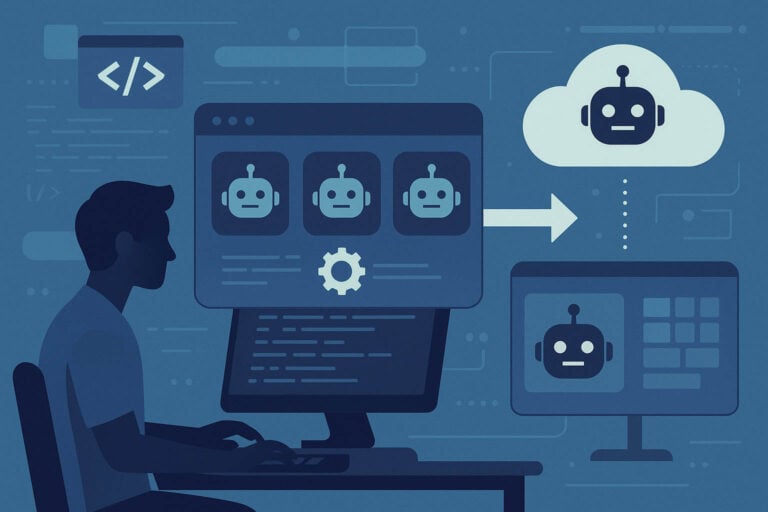
During the I/O 2026 developer conference, Google announced a major expansion of the Antigravity platform, an environment for building and managing AI agents. As part of this, the company is introducing, among other things, a standalone desktop application, a command-line interface, new APIs, and an SDK for developers.
With these announcements, Google is explicitly positioning Antigravity as a platform for so-called agentic AI: AI systems that independently perform, combine, and coordinate tasks. According to Google, Antigravity is thus evolving from a single product into a complete ecosystem for developers and businesses.
One of the most notable components is Google Antigravity 2.0, a standalone desktop application that allows developers to control AI agents locally. In addition, Google is introducing an Antigravity CLI, which enables the same agents to be used and managed from the terminal.
Google is also making the Antigravity agent available via the Gemini API. This allows developers to programmatically invoke agents from their own software or workflows. At the same time, a preview of the Antigravity SDK is being released, intended for building custom agents that use the same underlying agent environment as Gemini.
Google is also explicitly integrating Antigravity with existing AI development tools. For example, AI Studio Build will now also use the Antigravity agent environment. Developers can export projects from AI Studio to Antigravity, including the context of previous interactions with the agent.
Parallel Agents and Linux Environments
According to Google, multiple agents within Antigravity 2.0 can execute programming tasks in parallel. To this end, the platform introduces features such as dynamic subagents, designed for parallel workflows and background automation. Agents gain access to the editor, terminal, and an integrated browser to perform programming tasks independently.
Through new Managed Agents in the Gemini API, developers can also launch agents with a single API call that reason independently, use external tools, and execute code in isolated Linux environments. This is reported by SiliconANGLE.
For business users, Google is also bringing Antigravity 2.0 and the CLI to the Gemini Enterprise Agent Platform within Google Cloud. That platform was previously known as Vertex AI.
In addition, Google is introducing a new AI Ultra subscription for $100 per month. This is intended to give developers and businesses greater capacity to run AI agents and conduct experiments at scale.
Gemini 3.5 Flash at the core
Under the hood, a large part of Antigravity runs on Gemini 3.5 Flash, which Google says will become the new standard model for coding and agent tasks within the platform. The company claims that the model outperforms Gemini 3.1 Pro on various benchmarks for programming tasks and AI agents.
Google also states that researchers have used multiple Antigravity agents to autonomously perform complex tasks, including building a functional operating system.
Within Antigravity 2.0, Google is also introducing features for managing agents. For example, users can now set up Scheduled Tasks, which automatically start agents at fixed times or via cron schedules.
In addition, Google is adding project management, support for worktrees, and expanded sidebar functionality. Live speech transcription is also being integrated via the latest Gemini Audio models.
Google also announced CodeMender, a new AI agent for code security. It is designed to automatically detect vulnerabilities in AI-generated code and implement fixes.