
AMD posted strong results again in the third quarter of 2025, but the stock market reacted cautiously. The American chip company reported record revenue of $9.25 billion, up 36 percent from a year earlier, and net income of $1.24 billion.
Adjusted earnings per share came in at $1.20, slightly above analysts’ expectations of $1.16. Despite the better-than-expected results, the stock fell more than 3 percent in after-hours trading, after losing nearly 4 percent earlier in the day.
Investors were particularly disappointed by the outlook for gross margin, which is expected to be around 54.5 percent in the fourth quarter, virtually in line with market expectations. On the other hand, the revenue outlook is strong: AMD expects to generate approximately $9.6 billion, representing year-on-year growth of around 25 percent and exceeding the consensus of $9.15 billion.
Data center and AI divisions drive growth
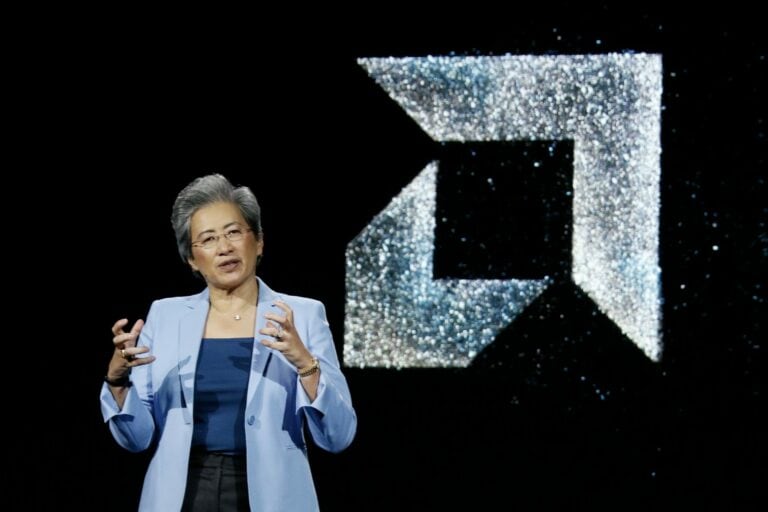
According to CEO Lisa Su (photo), the quarter reflects broad demand for AMD’s Epyc and Ryzen processors, as well as growing interest in Instinct AI accelerators. She sees the results as an important step in the company’s growth trajectory, with the data center and AI divisions remaining the biggest drivers.
CFO Jean Hu emphasized that AMD not only achieved record revenue, but also its highest free cash flow to date. She attributed the strong performance to a combination of a broad product portfolio and disciplined execution, with a focus on investments in artificial intelligence and high-performance computing.
The data center division achieved revenue of $4.34 billion, an increase of 22 percent compared to a year earlier and slightly above market expectations. However, operating profit lagged behind due to declining margins: from 29 percent a year ago to 25 percent now. Revenue growth was mainly driven by strong sales of fifth-generation Epyc processors and the new Instinct MI350 GPUs.
The client and gaming divisions also performed strongly, with combined revenue of $4 billion, an increase of 73 percent. Sales of Ryzen processors reached a record high of $2.8 billion, while the gaming division benefited from higher semi-custom revenues and strong demand for Radeon GPUs. The embedded division, on the other hand, saw revenue decline by 8 percent to $857 million.
Uncertainty about exports to China
A major point of uncertainty remains the export of Instinct MI308 GPUs to China. Although the US government has approved exemptions, AMD is still awaiting final license approval from the Department of Commerce. As a result, these expected revenues are once again not included in the quarterly figures and forecasts. If the exports go ahead, this could further boost revenues and margins, but investors seem to remain cautious as long as the situation remains unclear.
At the same time, AMD is strengthening its position in the AI market with new partnerships. Oracle plans to integrate 50,000 new Instinct MI450 GPUs into its cloud infrastructure next year. OpenAI is also preparing to deploy six gigawatts of AMD processors across multiple hardware generations in the coming years, starting with an initial capacity of one gigawatt. In addition, OpenAI is exploring the possibility of acquiring a ten percent stake in AMD through an option on 160 million shares.
Despite the decline in its share price, AMD continues to perform strongly on an annual basis: its value has more than doubled since the beginning of 2025, while the Nasdaq index rose by approximately 21 percent during the same period. The figures and announcements underscore that AMD is accelerating its growth path in artificial intelligence and data center technology, even though the market remains critical of its short-term profitability.