
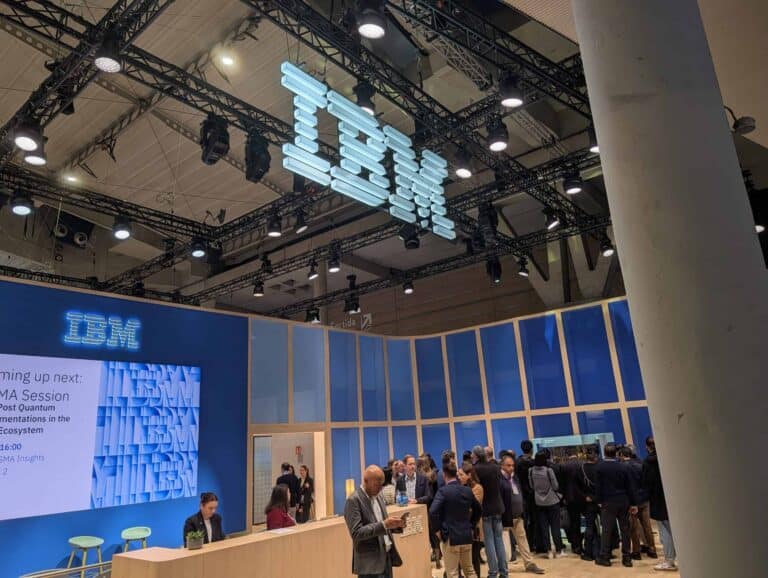
IBM is acquiring HRL Laboratories, a research lab previously owned by Boeing and General Motors. With HRL’s expertise in silicon-spin qubits, IBM is adding a second hardware track alongside its existing superconducting approach.
While IBM has primarily focused on superconducting qubits until now, the company is now opting for a dual strategy. According to Reuters, IBM is thus shifting to a “two-track” approach, in which spin-based technology will complement its existing processors.
HRL is considered a major player in the field of spin qubits. The group works with silicon quantum-dot spin qubits that are compatible with standard CMOS manufacturing. Silicon spin qubits operate at a warmer temperature of around 1 kelvin, compared to the millikelvin required by superconducting qubits. The circuits are also much smaller, enabling higher chip density. IBM emphasizes that both approaches rely on state-of-the-art silicon fabrication, making them both credible scaling paths.
“The HRL team will help IBM push even farther forward toward the frontiers of quantum innovation,” said Director of Research and IBM Fellow Jay Gambetta. In addition to quantum computing, HRL also brings expertise in quantum sensing, cryogenics, and control electronics.
Place in the roadmap
IBM is sticking to its existing plans. Quantum Starling, the first large-scale, fault-tolerant quantum computer with about 200 logical qubits, is scheduled for release in 2029. Blue Jay, capable of one billion quantum operations, will follow in the mid-2030s.
HRL’s spin qubits will become particularly interesting after Blue Jay, according to IBM.