
“It’s only a matter of time before the others follow suit,” we wrote early last year when discussing the first hyperscaler to adopt Everpure’s (then Pure Storage) direct-flash technology. 18 months later, we now have number two. This is also a top-5 hyperscaler whose name we’re not allowed to disclose. That hyperscaler is going to design an infrastructure with direct-flash as its storage foundation. That’s undoubtedly a major step forward for both the hyperscaler and, certainly, for Everpure.
An efficient design of the storage layer and the associated software can yield significant benefits, especially at scale. For hyperscalers, the majority of storage still takes place on HDDs, largely due to the relatively low prices of hard drives. However, switching to flash can offer many advantages. Again, this especially holds at the scale at which hyperscalers operate.
Read also: R&D is the lifeblood of Pure: a peek behind the curtains
Everpure CTO Rob Lee told us last year that virtually all hyperscalers have or had internal projects in which they actually wanted to build the direct-flash technology that Everpure has made its name on. While that’s technically possible, it’s not the easiest way to go about it. That’s why first one hyperscaler approached Everpure to work with the company to explore how this technology can be integrated into their infrastructure. Now, a second hyperscaler have done the same.
If you want to know exactly how Everpure’s Direct-Flash Modules work, we refer you to the following article: Pure Storage aims to make hard drives permanently obsolete
No FlashArrays or FlashBlades, but a design partnership
It’s important to note here that today’s news doesn’t mean the second hyperscaler is going to fill data centers with FlashArrays or FlashBlades, the systems Everpure sells to customers. This is explicitly a so-called “design win.” The hyperscaler is interested in the hardware and software that enable Everpure to build the FlashArrays and FlashBlades. Moreover, it intends to build around these components to create what it deems necessary and what fits within its own infrastructure.
Specifically, Everpure supplies software and components to the hyperscaler. These are explicitly “non-NAND” components. The hyperscaler itself purchases the hardware modules (which include the NAND). Everpure therefore does not supply complete DFMs, but only the components that make a DFM a DFM.
What does this mean for Everpure?
With announcements like this, it’s always a bit of a guess as to how significant the impact on Everpure will be. Will the hyperscaler roll this out on a limited scale, or is the intention to deploy it across its entire infrastructure? And how quickly will all of this happen?
When releasing the news, Everpure also prepared a Q&A for investors. It doesn’t contain very concrete answers regarding the scope of the rollout within the hyperscaler’s infrastructure. It is clear, however, that Everpure will have to wait a while before the current design win becomes visible. That makes sense, since the hyperscaler and Everpure need to work on the design first.
According to Everpure, the company expects the impact of the current agreement to become visible for the first time in FY28. Everpure states that the contribution to revenue will be “significant” in FY28 and will ramp up towards the future. As it is now, Everpure does not yet break out revenue from these types of deals in its quarterly and annual reports. Therefore, the actual revenue figure will remain a matter of speculation for the time being.
For Everpure, securing its second hyperscaler is further evidence that the development of direct-flash about a decade ago was the right move. For HDD manufacturers, it looks like they’ll have to cede yet another slice of the market.
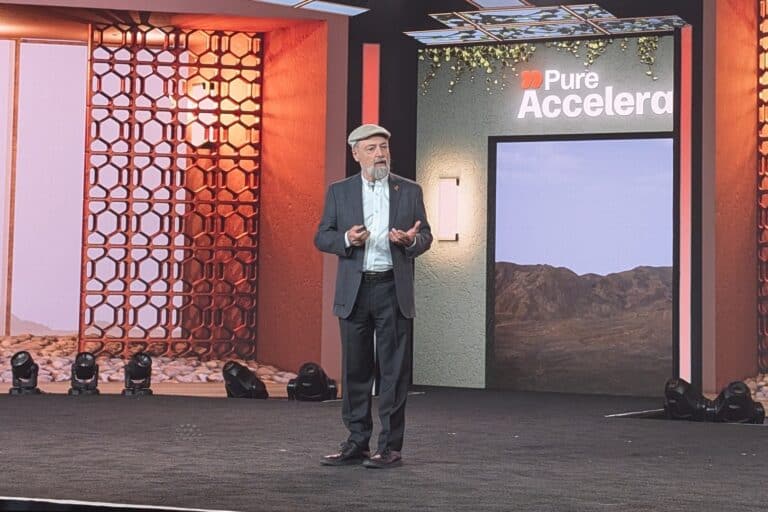
Image: Everpure CEO Charles Giancarlo on stage at Pure Accelerate earlier this year.