
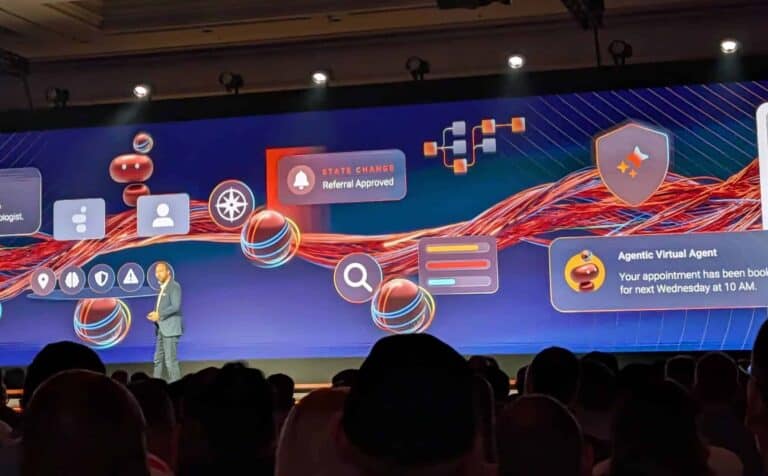
Genesys positions Genesys Cloud as an agentic orchestration platform. Guillaume Lardeux, Head of Transformation, says full autonomy isn’t the goal. According to him, most companies are still in the assisted AI phase, using bots and copilots, while the real value lies in end-to-end orchestration. We spoke with Lardeux, who also serves as Office of the CEO, about the transformation companies are undergoing.
A conversation with Genesys quickly turns to the contact center’s changing role. The software platform has really made a name for itself in that domain, but with the rise of agentic AI, a great deal has been happening there for several years now. When reflecting on the current shift, Lardeux draws on considerable experience: he has been with Genesys for 26 years. Initially, the focus was primarily on Computer Telephony Integration (CTI), followed by, among other things, the transition from on-premises to multi-channel, from voice to digital, and the leap to the cloud.
Now a new phase is underway. “And now we’re fully in the era of agentic AI and agentic orchestration,” says Lardeux. Genesys Cloud, also described as the agentic orchestration layer, plays a central role.
Tip: Time for a new operating model? Genesys revamps agentic orchestration layer
From assisted AI to true transformation

In his role, Lardeux is responsible for two areas of transformation: transformation at customer sites and the transformation of Genesys itself. Internally, this involves how the company is managed; externally, it concerns how organizations are redesigning their customer interactions.
What he sees among those customers is, above all, a shift in expectations. According to Genesys research, 92 percent of consumers expect every company they deal with to provide the same quality as the best experience they’ve ever had. Personal use of ChatGPT and similar tools raises the bar even higher.
But the reality is less ambitious. Most of what companies have built so far falls into the category of assisted AI. This includes first-generation chatbots, built-in copilots, and post-conversation summaries. While useful, the work process itself remains the same. According to Lardeux, the real opportunity lies elsewhere: traversing the entire chain from the initial signal of intent to business results.
He summarizes the shift as a move from the service economy to the experience economy. In the old model, the customer waited, was transferred, and had to repeat their story. Now, that customer wants a quick resolution, no repetition, and a personalized approach.
Autonomy is not the goal
Lardeux does not want to subscribe to the vision of a fully automated contact center. In his view, complete autonomy is not the goal. The goal, however, is to achieve better business results. This involves factors such as customer loyalty, retention, and higher conversion rates. Automation can support this, but it should not be the end goal.
The division he outlines is quite pragmatic. Repetitive tasks are well-suited for technology. Complex, emotionally charged, or sensitive conversations remain with humans, often with a “human in the loop” who verifies that the correct response is provided. Additionally, there’s the volume argument for automation. Wait queues at contact centers currently exist simply because there aren’t enough people, and the number of interactions continues to rise.
In this context, Lardeux sees voice as truly important, and perhaps becoming even more so. After years in which digital customer service was the dominant theme, Genesys is seeing voice grow again, both through human agents and AI-powered voice.
This could positively impact contact center employees. Lardeux cites not only higher customer satisfaction but also higher employee satisfaction. Employee turnover is one of the biggest challenges in the industry. He sees better tools as a win-win.
Open ecosystem to prevent new silos
For Genesys, as an orchestration layer, it’s important to address silos. This can be achieved through deep integration with systems where many customer experience interactions take place. At the SaaS level, Salesforce and ServiceNow are key partners the platform integrates with. Genesys’ front-office expertise (such as phone and chat channels) can then be combined with Salesforce (customer contact in CRM) and ServiceNow (back-office functions such as ticketing and workflows). At the infrastructure level, AWS plays a key role by providing computing power and, for example, powerful AI models via Amazon Bedrock.
Lardeux does, however, warn against too many standalone point AI solutions. This increases the risk of silos. A standalone application that cannot communicate with the rest of the landscape leaves the customer trapped in that silo. According to him, orchestrating the entire chain is what delivers a good customer experience, not the number of tools.
Tip: Genesys expands AI ecosystem with Adobe, Meta, and ElevenLabs
Pinkfish accelerates its roadmap
Lardeux is also involved in M&A. The largest transaction of the past year was the acquisition of Pinkfish in June. Pinkfish built a solution for agent-based orchestration workflows and brings with it 500 integrations and approximately 25,000 MCP tools. Genesys is now integrating these into its platform so all users can benefit.
According to Lardeux, the acquisition of Pinkfish truly accelerates the company’s current trajectory. Genesys was already on this path; it saw what Pinkfish had built and chose to acquire the existing integrations and tools rather than develop everything in-house. It’s the classic “build or buy” dilemma, and in this case, it chose to buy.
Ultimately, Lardeux still views the current phase the business world is in as just the beginning. In his view, organizations are only at the start of what AI can mean for transformation. He believes the coming years will be truly decisive.