
Veeam is expanding beyond backup and cyber resilience into a broader ‘data and AI trust’ platform. This comes after its $1.7B acquisition of Securiti AI and the launch of its DataAI Command Platform. In an interview with Techzine, CEO Anand Eswaran outlines the phases the company is going through.
Veeam has earned its reputation as a platform for reliable backup and recovery, with the primary goal of restoring data after an incident. In that segment, the company has also become the market leader, leaving established names behind with annual revenue now exceeding $2 billion. The Instant Restore feature, in particular, attracted many companies to the Veeam platform, reducing the recovery time objective to just a few minutes by enabling VMs and servers to be restored from a backup file within minutes.
As the platform expanded, the company also increasingly focused on cyber resilience. This was partly driven by the explosive rise in ransomware, which regularly targeted backup files. If cybercriminals successfully compromised these files, they gained immense leverage in their attempts to extort ransom payments. As a result, in addition to restoring data, ensuring that data is free of malware before it goes back into production became crucial. This is where the incident response service comes into play, offering services ranging from triage to ransomware negotiation and from forensic investigation to decryption.
Backup and cyber resilience truly form the foundation now, and that’s not going to change anytime soon. Eswaran makes clear that with the advent of the agentic AI era, something new is emerging that Veeam will also focus on. This is something much bigger that requires a new product. “I think the first two eras had one thing in common: the person at the center was always human,” says Eswaran. “The actor is not human in the new era. The speed, the impact, and the explosive power that the era of the agent brings with it require a completely different architecture.”
Millions of agents, one vulnerable data layer
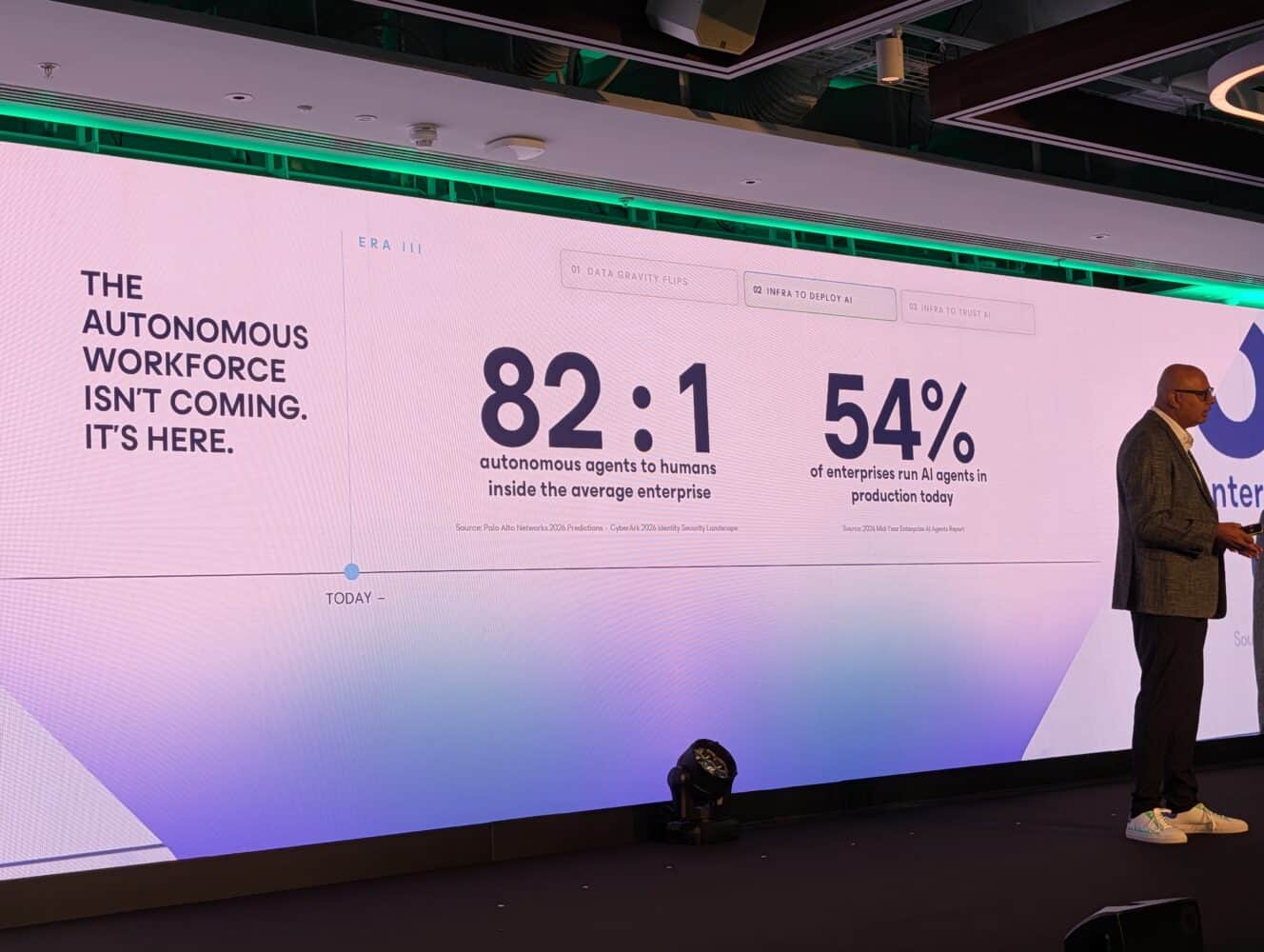
That third era—the agentic era—revolves around AI agents operating at machine speed. Eswaran shares concrete figures: an average of 82 autonomous AI agents per human employee, 97 percent of which are “over-provisioned” and have access to virtually all corporate data. Systems of record, data warehouses—all of these are wide open. To illustrate this with a real-world example, Eswaran cites the case of PocketOS. This coding agent completely deleted both the production database and the backups in 9 seconds. That demonstrates just how dangerous autonomous agents can be.
That irreversible reality is precisely the problem Veeam aims to address. Traditional perimeter protection doesn’t work if the “attacker” is an internal system. And mere monitoring isn’t enough. Once an agent has accessed data, a breach has already occurred. Veeam therefore opts for a different architecture. Instead of monitoring agents, the company aims to place control directly with the data, so that identity checks accompany the data throughout its entire lifecycle.
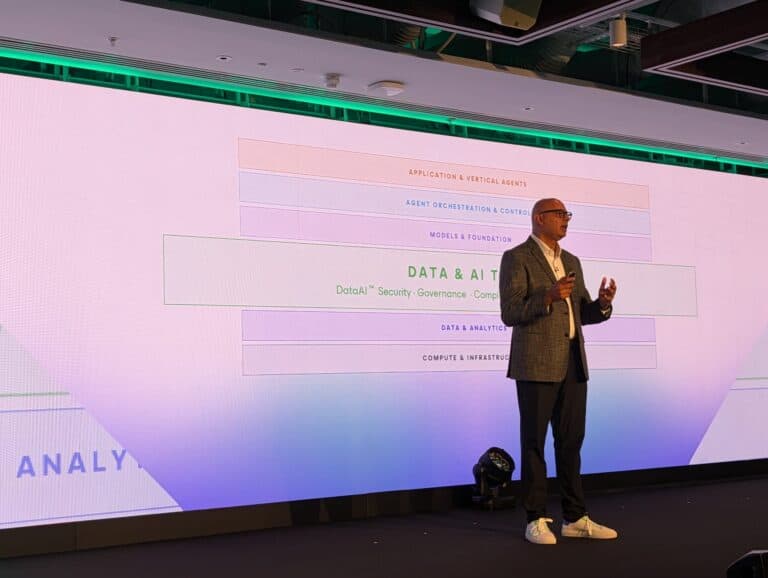
This approach resulted in the DataAI Command Platform. The platform brings together data, access, identities, and AI into a single connected trust layer that sits above the data & analytics and compute & infrastructure layers, but below the models and agent orchestration. At its core is the DataAI Command Graph. This is an intelligence graph with connectors to more than 300 systems, down to the element level in the data. It is the first multi-domain intelligence graph in its category. Note that while this new platform includes backup and resilience capabilities, it exists separately from existing, well-known resilience solutions such as the Veeam Data Cloud and Veeam Data Platform.
Securiti AI as the Foundation
The new platform would not exist without the acquisition of Securiti AI. Veeam acquired the company in late 2025 for $1.725 billion, providing organizations with a combined platform for data resilience, security, and AI trust. Why Securiti and not one of the other players in the DSPM market? Eswaran told Techzine that Securiti is the best of its kind. He points to analyst reports from GigaOM and others that show Securiti leading by a significant margin in classification accuracy. According to Eswaran, the knowledge graph the company built has no counterpart, not even among broader security firms. With Rehan Jalil, former CEO of Securiti, the company also brought on board a leading technological architect. He will continue at Veeam as President of Products & Technology.
Jalil himself sees security, privacy, and compliance as essentially controls over the same data. Backup, in that context, is a copy of that live data. That insight makes the combination logical: instead of five separate tools on five separate datasets, there is one integrated layer.
Precision Resilience and New Target Audiences
What also makes the DataAI Command Platform interesting is what Veeam calls “Precision Resilience.” Suppose a company has 250,000 agents. In that case, a full rollback to the last known good state is unfeasible. “You have to undo exactly that one file, those 5 seconds, that one wrong decision,” Eswaran explains. This places different demands on the architecture than traditional recovery. Simply monitoring agents is insufficient. By the time an agent does something malicious and you intercept it at runtime, data access has already occurred. A breach has already taken place. Controls must therefore be wrapped around the data, with identity checks traveling with it throughout its lifecycle. This applies to both production and backups.
This also touches on a broader shift in Veeam’s user base. Until now, this base has largely consisted of infrastructure administrators and IT teams. With the new platform, the CIO and CISO are also becoming primary decision-makers. Furthermore, chief risk officers, privacy officers, and compliance officers may be involved in AI governance. Eswaran expects the CISO to become the primary influencer as these domains converge onto a single data platform.
Eswaran also foresees a bright future from a commercial perspective. Veeam recently reported $2.1 billion in annual recurring revenue (ARR). Eswaran indicates he expects significant ARR growth now that the DataAI Command Platform is gaining traction with existing and new customers. He does not want to cite specific figures, but “several billion shortly” is the direction, indicating the huge potential of Veeam’s newest shift.
Tip: Veeam DataAI Command Platform to Feature AI Agents for Privacy Compliance