
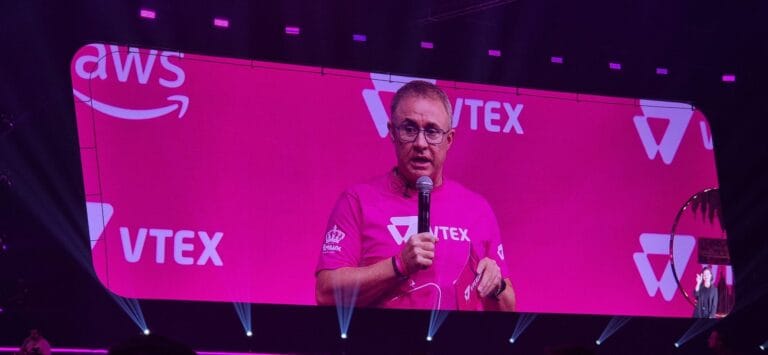
At VTEX Day 2026 in São Paulo, VTEX presented its three products for the first time as a single integrated AI-native suite. With the new AI Workspace, a completely rebuilt CX Platform, and integration with Google’s Universal Commerce Protocol, the company is focusing on an operational model where AI agents do the heavy lifting and humans take the lead. Co-CEO Mariano Gomide paints a picture of a market that is consolidating at the enterprise level into three platforms. VTEX wants to be one of them.
The employee who spends their days browsing catalog pages, tweaking search terms, and rolling out promotions is disappearing. Not because the work is disappearing, but because AI agents are taking it over. What remains is a different role: people who direct, guide, and provide context to those agents. That was the central message at VTEX Day 2026, which took place on April 16 and 17 in São Paulo.
This year, the event grew to become the largest commerce event in the world. All 50,000 tickets were sold out, and visitors from 22 countries had made the trip to Brazil. Techzine was on site and spoke with co-CEO Mariano Gomide de Faria and VP of Product Alexandre Gusmao, who is responsible for the product portfolio. Both left no room for misunderstanding: the change isn’t coming—it has already begun.
Integrated AI-native suite
For the first time this year, VTEX presented its three products as a single integrated suite: the Commerce Platform, the CX Platform, and the Ads Platform. Gomide describes it as a “tripod of sustainable growth” and explains what native integration means in practice. “What used to be a decision that took one, two, or three months, backed by research and analysis, you can now test in a single day,” he says. Because the CX Platform is built directly into the Commerce Platform, every VTEX customer can launch a working WhatsApp store within a day, complete with autonomous return tracking. Without the need to integrate systems from different vendors and without a weeks-long implementation process.
The Ads Platform adds a third dimension to this. Over the past fifteen years, retailers could hardly avoid the Meta and Google duopoly when it came to driving traffic. Gomide is clear on this: “Retailers and brands were held hostage by an expensive duopoly, and nobody complained.” The emergence of new players like OpenAI and Anthropic as traffic channels is now beginning to break that duopoly, which he believes is actually good news for retailers. More channels mean less dependence and better margins. With the Ads Platform, VTEX aims to capitalize on this: retailers can use their own digital environments as advertising channels for brands and thus build a revenue stream independent of Meta and Google. During the keynote, VTEX demonstrated how an agent can create ad material within minutes, automatically check it against brand guidelines, and publish it, while another agent then monitors and adjusts campaign performance. Everything is integrated into the same platform that powers the store and handles customer service.
AI Workspace: four agents, one cockpit
The most significant announcement was the VTEX AI Workspace. The platform features four native agents, each monitoring a specific domain: catalog management, promotions, search optimization, and business insights. VTEX delivers these agents ready-to-use, pre-trained on its own best practices, and fully familiar with VTEX APIs and services. Merchants then add their own business context to this. A retailer with its own style of product descriptions writes its guidelines in plain language in a document and uploads it. The agent takes this into account with every recommendation it makes.
Those recommendations are exactly where the system proves its value. Large retailers manage hundreds of thousands to millions of product references, known as stock-keeping units (SKUs). It is impossible to manually monitor the quality of all of them. A catalog agent does this continuously: it flags a sparse product description, a low-quality image, a missing specification, and proposes an improvement along with an implementation plan. The employee approves or makes adjustments. The agent executes the changes. If something goes wrong, the system automatically reverts the changes as soon as it detects a negative impact on a business metric.
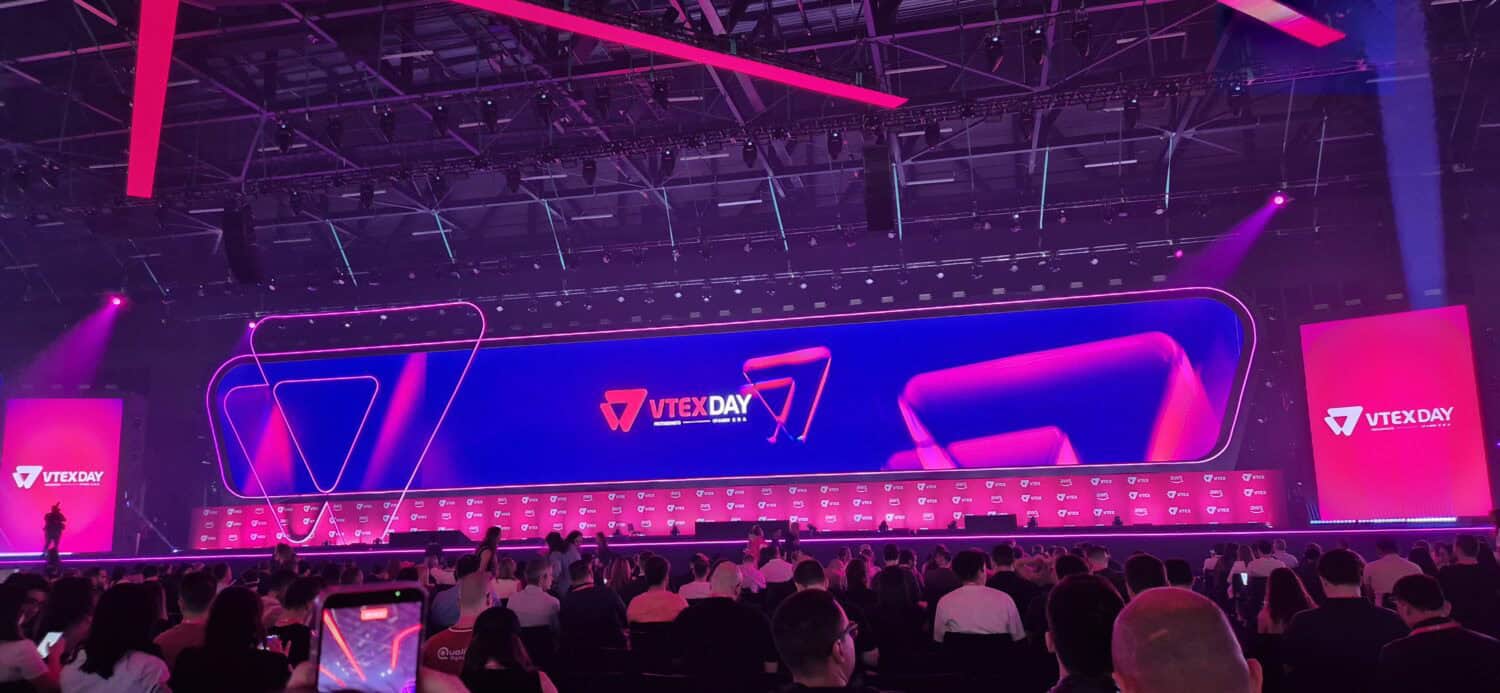
During the live demo on stage, Gusmao demonstrated the practical benefits of this approach. A search optimization agent that had implemented an adjustment a week earlier generated an estimated incremental revenue of eighty thousand Brazilian reais per month for that single client, equivalent to approximately thirteen thousand euros. “This is changing the operational model of e-commerce,” he stated.
Agent Marketplace
In addition to the four standard agents, VTEX is announcing an Agent Marketplace within the Workspace. This means that third parties, such as software vendors and system integrators, will soon be able to build and offer their own specialized agents via the same platform. VTEX will open this marketplace to the entire ecosystem shortly. Exactly which agents will emerge from this remains to be seen, but the architecture is ready for it.
As for the potential impact of the Workspace as a whole, Gomide leaves no room for misunderstanding: a retailer currently running its operations with 100 people will soon be able to do so with just 20. “Those who have the courage and daring will reap the rewards,” he adds. But Gusmao immediately qualifies that statement. “We’re still in the early stages. We see thousands of recommendations generated by agents—recommendations that simply wouldn’t be made without this system. But exact savings in FTEs can’t be quantified yet.” For now, the benefit lies in revealing opportunities that human teams miss, not in directly replacing people.
“What directors, owners, and founders need to figure out is what they’re going to do with those 80 people,” says Gomide. His answer: build new sales channels that don’t exist yet. “New channels bring diversity in revenue, more revenue, lower costs, and organic channels. And then profitability suddenly grows.” He also sees a broader shift in the types of people needed. Marketing departments now work almost exclusively with images. “Eighty percent of every retailer’s spending goes toward images,” he says. “That needs to shift toward words.” The marketing department that acts quickly and adds copywriters who train agents to speak in the brand’s voice has a head start.
Built from the ground up
The VTEX CX Platform is a different story, because it was literally rebuilt from the ground up. A year and a half ago, VTEX acquired the Brazilian company Weni, a conversational AI player built on workflow-based logic where every possible customer interaction had to be explicitly programmed. In the world of large language models, that paradigm had become obsolete. “Weni’s model was outdated, so we made the decision to rebuild the entire architecture from scratch,” says Gusmao.
The result is a multi-agent architecture in which a central agent manager communicates with specialized agents via the agent-to-agent protocol. If a customer asks a question about their order, the manager recognizes the context and activates the order management agent, which provides feedback to the customer via the manager. The setup is significantly simpler than the old workflow model. “You no longer have to anticipate every possible conversation path and question,” says Gusmao.
Concrete results
VTEX demonstrated that the platform is already live and delivering results through three specific applications. The most concrete is customer service: questions about orders, returns, and payments are handled autonomously more than 90 percent of the time, without human intervention. Gomide cites figures from his clients who report that their call centers are handling 80 to 85 percent fewer calls.
The second application relates to conversion. If a customer abandons their shopping cart without checking out, the agent detects this and proactively sends a WhatsApp message. This was demonstrated live during the keynote: the CEO of the CX Platform was interrupted in the middle of a purchase demo by a phone call from his daughter. After hanging up, he received a WhatsApp message from the agent who had picked up the abandoned purchase and helped him complete it.
The third application occurs earlier in the purchasing process, during the so-called discovery phase. Especially in specialty stores, customers often have specific questions about a product before they feel confident enough to buy. VTEX has built the CX agent directly into the product page of the online store. A customer who is unsure can ask a question like “is this right for me?” and is immediately connected with an agent who knows the specifications, purchase history, and reviews. “That gives the customer more confidence in the product before the purchase,” says Gusmao, “and that has a direct impact on conversion.”
Google UCP
One of the most strategically significant announcements at VTEX Day was the integration with Google’s Universal Commerce Protocol (UCP). VTEX is one of the first platforms in the world to be authorized for this. During the keynote, this was demonstrated live with the American golf retailer Worldwide Golf. A user in Google AI Mode asks for a suitable golf club in plain language, receives a personalized recommendation, and completes the purchase without leaving the Google environment. The order is processed via VTEX.
However, there is an important caveat: the UCP integration is currently available exclusively in the United States. Gusmao states he cannot comment on a potential European rollout; that is up to Google. Gomide views the authorization as a strategic advantage that is difficult to replicate. Not every software provider operating in a retail environment automatically gains access to Google’s compliance and privacy framework. VTEX does have that access.
Three platforms survive
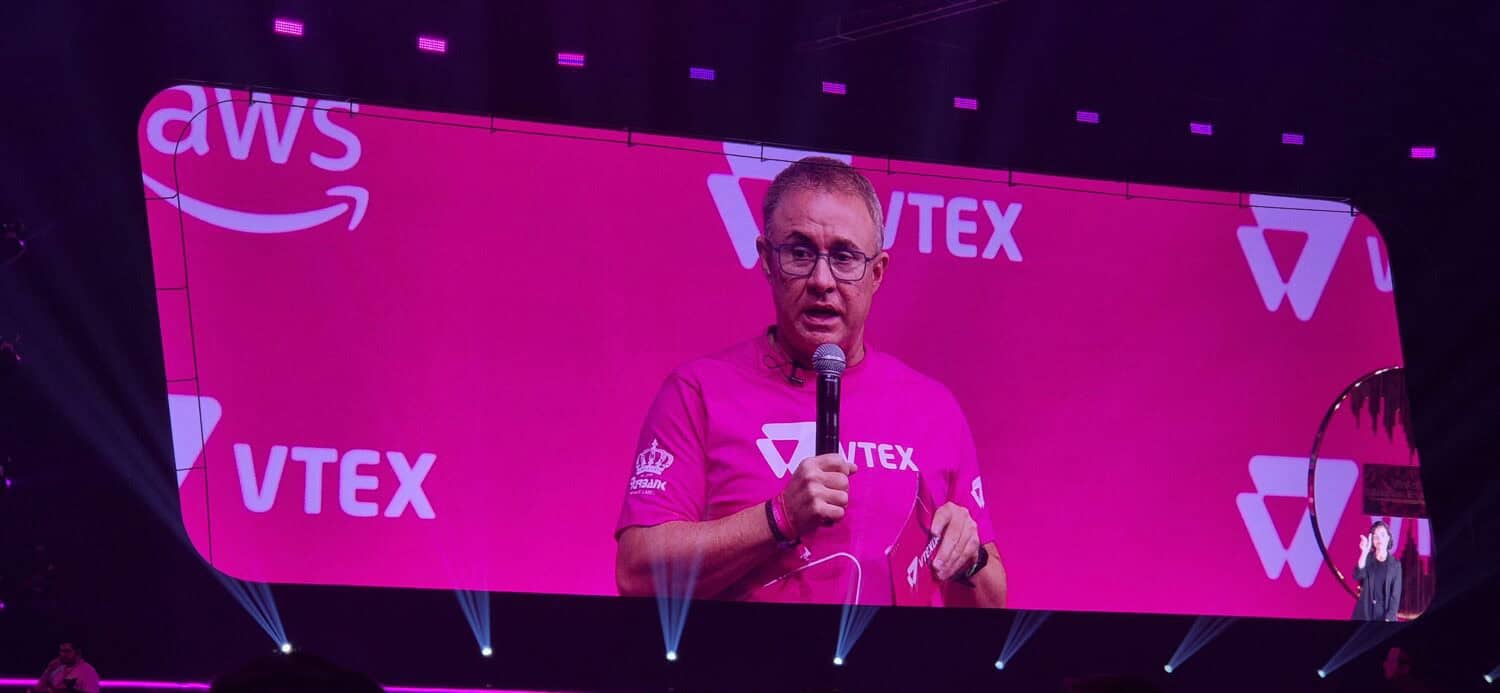
In a personal conversation with Techzine, Gomide offers a clear vision of where the enterprise commerce market is headed. He speaks from experience: VTEX has been around for over 25 years, and he has seen the market shrink from 42 e-commerce platforms to the current situation, where he counts only 6 serious players at the enterprise level. According to him, two of those are already up for sale, though he refuses to say which ones. He predicts that the market will eventually consolidate into three.
He definitely counts Salesforce among those three. For the remaining spots, he names two serious candidates. Shopify is the first, but with one key condition: the company must decide to become a software company rather than an aggregator and payment processor. “They have a great team, a great culture,” says Gomide. “But if they make the move to enterprise, they’ll lose their payment business. And the market won’t appreciate that.”
Adobe as a wild card
Adobe is the second candidate, specifically not with Magento but with a successor to it. “Adobe has a great stack and a great team. It’s an incredibly profitable company. If AI doesn’t destroy Adobe before Adobe transforms itself, it will become a major player,” says Gomide. It’s a statement that is both respectful and alarming. Gomide largely leaves SAP and Oracle out of the equation: they’re fighting a different battle at the level of cloud and data infrastructure. Moreover, Oracle’s commerce division has since been dissolved.
Gomide leaves no doubt about where VTEX sees itself. “We are determined to be one of those three,” he says. He backs up that ambition with a structural cost advantage that enables VTEX to compete with players that have much larger budgets. 100% of the engineering is based in Latin America, where, according to him, a top developer costs one-tenth as much as a comparable engineer in Silicon Valley while delivering equivalent output. “That’s arbitrage. And arbitrage is the fastest way to create value,” he says. Simplicity wins, he adds. “Simplicity is the ultimate form of innovation.”
Side Note
Gomide’s market vision is outspoken, and his ambition is unambiguous. But anyone spending two days at VTEX Day also sees a different reality. The majority of the sessions were in Portuguese. International clients were present, but they were predominantly local representatives of major brands who spoke in Portuguese about how well VTEX works. A handful of sessions were in English. The press conference for the international press was held in Portuguese.
That says something. A company seriously aiming for third place in a global market worth two to three trillion dollars will ultimately have to make its move outside Brazil. Gomide mentioned triple-digit subscription growth in Europe but declined to elaborate further. The ambition is there. Whether the international scale is already in place is another question.